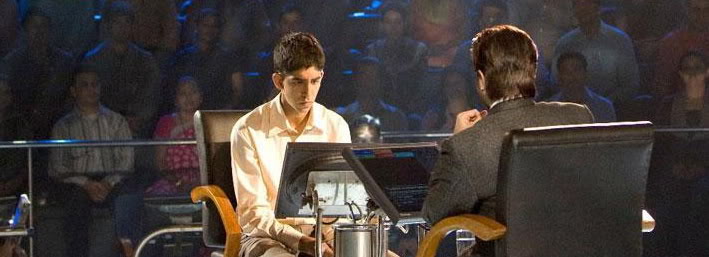
Ever since director Danny Boyle trained his camera on Ewan McGregor and his blokes racing through the streets, it’s been clear that he’s a relentless visual stylist. Boyle is feverishly interested in finding new, dynamic ways to tell stories through kinetic imagery. Like a Steven Spielberg film, it’s easy to imagine watching a Boyle offering without any soundtrack whatsoever, letting just the pictures tell the story. But while Spielberg’s visual storytelling is based on elegant narrative clarity, Boyle’s is bursting, shifting, pummeling. Spielberg is grounded; Boyle is electricity, ricocheting rapidly, unpredictably through the air. I can easily imagine Slumdog Millionaire as shot through Spielberg’s lens, its feel-good story of a young Indian man who defies expectations engendered by his impoverished upbringing to triumph on his country’s version of Who Wants to Be a Millionaire? It would be sleek and moving and manipulative, sidestepping between past and present as deftly as Gene Kelly traverses a rain-soaked curb. In Boyle’s hands, it’s a different creature: jittery, spirited, galloping and willfully ragged. That approach is thrilling in its originality and yet distancing. It can be hard to get close to characters when you’re always aware of the camera whirring in between.
Adapting a novel by Vikas Swarup, Full Monty screenwriter Simon Beaufoy has given Boyle a playfully intriguing story. The game show mastery of the protagonist, Jamal, isn’t in defiance of his “slumdog” origins, it’s completely because of them. The narrative zings between three threads: the boy’s hardscrabble life growing up in Maharashtra, his question-by-question climb out of poverty on the brightly lit studio floor, and his interrogation at the hands of police officers convinced he’s perpetrating a fraud. The questions dished up to Jamal represent a sort of personal perfect storm of quiz show queries. Nearly every question relates back to some momentous occurrence in his life, so, no matter the difficulty, he has the answer at the ready. (Luckily enough, the ordering of the questions also corresponds to the chronological trajectory of his life’s events, keeping the narrative fairly easy to follow.) Some of these connections are strained, some are ingenious, but all carry the satisfying message that our kneejerk judgments about whose knowledge is valuable merits reconsideration.
My old radio movie show cohort used to opine that film critics should be obligated to periodically inform perusers of their assessments that the sheer number of films they need to see and the accompanying familiarity with standard storytelling patterns undoubtedly impacts their enjoyment of certain films. In other words, what is predictable to them may be fresh and surprising to a more modest consumer of film. While I’m far from someone who can claim that professional title, I think it’s worth noting due to a particular experience I had watching the film as part of a full, attentive audience. The final question Jamal will be asked on the game show set is, I think, fully apparent from the moment it is set up in the film, some ninety minutes or more of running time before it is posed. Despite this, it was greeted with audible delighted surprise by the majority of the audience. This predictability doesn’t bother me–I find the set-up and pay-off fully satisfying and that sequence has several other elements that are artfully utilized–but it may help explain why this film which has inspired thrilled gushing from so many (including the distinguished gentleman cited at the head of this paragraph) leaves me only lukewarm. I’m more interested in the way Boyle incorporates subtitles into his frame like they’re free-floating captions than I am in the underdrawn love story that is the film’s backbone. I liked watching the puzzlebox solve itself, but it didn’t move me.
Discover more from Coffee for Two
Subscribe to get the latest posts sent to your email.
 Coffee for Two