Sometimes, especially at this time of the year, seeing a movie is liking taking a big spoonful of medicine. Studios notably and notoriously stockpile most of their product that has merit beyond its expected appeal to narrow demographic groups like mouth-breathing teenage boys who like shape-shifting robots and spirited young women who like prefer their moviegoing to be a mere component to cocktail-fueled girls’ nights out. There are benefits to this. Without the allure of little golden men, there are plenty of worthy, rewarding movies that would have never made it past the pitch stage. But then there are the legion of self-serious important dramas that are as calculated as the most cynical summer blockbuster.
The Reader is so loaded with somber topics that I half expected the film to conclude with one of the stars stepping out of character to list the books recommended by the Library of Congress for those looking to do a little outside reading. It’s pretty remarkable for a movie deeply concerned with the lingering shadow of The Holocaust to make room to make room for other grave social ills. Even more, it comes up with something that, adhering to the logic of the movie, carries more public shame than admitting to being the dispassionate mastermind of Nazi war crimes. Just imagine.
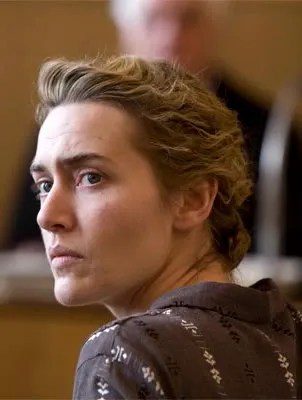
Kate Winslet plays the film’s central figure, a woman who takes a teenage boy as a lover in mid-nineteen-fifties Germany only to abandon him and reemerge as a defendant in a war crimes tribunal several years later. Winslet, as usual, is quite strong. She brings a quiet firmness to the role, a stern quality that, frankly, seems very German. She fills in the corners of her character, giving her a level of humanity that the rigid, largely uninteresting script largely ignores. It’s a measure of the film’s stiffness that the moment that feels the most alive is a classroom debate on the entire country’s culpability in a atrocities of World War II.
In some ways, that stiffness is actually an improvement for director Stephen Daldry, whose previous film, The Hours, suffered from a visual jumpiness. He’s calmed his camera and quelled his desire to edit the film in stuttering proof that a transplanted stage director can use movie techniques just fine. That unseemly anxiousness set aside, Daldry has proved little more than his ability to make a movie that is plain and dull.
The Reader isn’t damnably bad. It’s just mundane. Sometimes in filmmaking, that can be the greater crime.
(Posted simultaneously at “Jelly-Town!”)
Discover more from Coffee for Two
Subscribe to get the latest posts sent to your email.
 Coffee for Two
I find your media musings quite insightful and entertaining. Your writings remind me of certain friend of mine. Keep up the quips!
WTW.