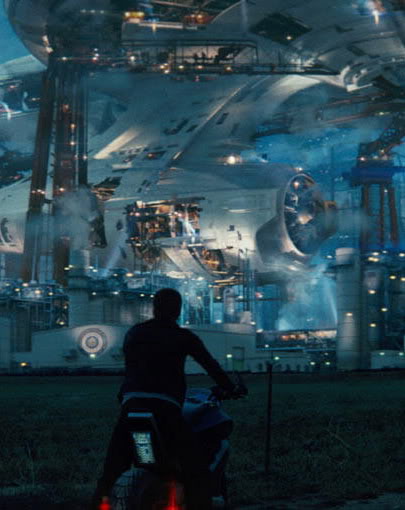
If it’s still true that familiarity breeds contempt, then there must be a lot of contemptuous people buying movie tickets these days. While I still subscribe to Manohla Dargis’s assertion, made in defense of a movie I find mediocre at best, that Hollywood’s reliance on pilfering from its own established accomplishments is hardly a new phenomenon, there is still a certain weariness that settles in at the dawn of each new summer movie season. The calculation of what films are piled into the air-conditioned auditoriums is so complete that original ideas are nearly as unlikely as a twentieth anniversary theatrical re-release of Lock Up. Studio decision-making has no room for inspiration. Product is king. That just makes it all the more thrilling when a film that falls squarely into the category of franchise fodder proves to be utterly winning and resoundingly entertaining. And that, improbably, is the case with Star Trek.
Given the helm of the starship Enterprise, director J.J. Abrams and the screenwriting team of Robert Orci and Alex Kurtzman deliver a spectacular reinvention. The seasoned vessel was increasingly beleaguered, worn down by an overabundance of spun-off tedium and film efforts that had shifted from the strangely charming odd-ones-are-bad-even-ones-are-good pattern in the eighties and early nineties to a slowly draining sink basin of increasingly woeful efforts. After years of fervently guarding their cash cow (fueled in no small part by the demands of fans who practically invented the notion of proprietary feelings towards favored art now devoutly practiced in all modern cathedrals of geekdom), Paramount saw it was time for a Hail Mary pass, or, maybe more appropriately, a totally insane tactic desperately employed to try and best the Kobayashi Maru test. Abrams, Orci and Kurtzman, it seems, were given the chance to cast off the reverence that’s had a mummifying effect and tackle the the Trek universe anew. The result is a film that’s smarter, shrewder and more relevant than any other feature film that bears the Star Trek name.
They’ve managed to reboot the franchise without discarding the material that has come before, deftly utilizing a standard sci fi tactic that was used and abused by Trek scripters over the years. We have the crew from the original series–James T. Kirk, Spock, Leonard “Bones” McCoy and all the others–recast with new, youthful actors, playing out the very beginnings of the characters, from glimpses at the boyhoods of the two most prominent graduates of Starfleet Academy through to a fresh take on how this particular band of spacebound brothers first came together. In the conception, in the casting, in the details of the script, the filmmakers walk the fine line between homage and reinvention, tapping into the familiar elements of characters and storylines created for a modestly groundbreaking NBC series forty years, but rarely relying on pure nostalgia to carry a scene. The little gifts to knowledgeable fans are plentiful and artfully deployed. They are also integral to a well-constructed story that is devilishly complicated and yet clear as a cloudless, starry sky.
It’s hard to fathom the added challenge for these new actors in such well-worn roles. These parts forever defined the actors who originally played them and the sense that they are traps as much as they are opportunities had to be pronounced. What’s more, some of the patterns, traits and twitches of the original portrayals are thoroughly ingrained into the pop culture consciousness. How do you play a role previously defined by William Shatner when every third person has their own William Shatner impression? If you’re Chris Pine, you apparently do it with wit and aplomb, seemingly having the time of your life in the process. Pine allows himself a handful of Shatneresque line deliveries, but they’re used judiciously. If you’re going to juicily overact like the master himself, there’s no better place to do it than in the spirited fakery of a classroom simulation. Mostly Pine conveys a mix of egotism and headlong bravado in James T. Kirk. And, gratifyingly, he makes the tumbling toil of the action sequences look like genuinely hard work. His Kirk always looks a little battered when he strolls away from a triumph. Among the rest of the cast, I’m especially fond of Karl Urban’s grouchy impatience as Dr. Leonard “Bones” McCoy, and Zoe Saldana’s Uhuru is more urgent and fascinating than anything that Nichelle Nichols was ever able (or, maybe more accurately, allowed) to realize. Finally, there may be no greater compliment that can be paid to Zachary Quinto’s Spock than to note that it is the one performance that must bear up to the scrutiny of a direct comparison with the acting of his predecessor in the role, and it does so admirably.
This is the second feature film directed by J.J. Abrams, after the unwatchable Mission Impossible III. His inability to shepherd M:i:III to decipherability hardly seems to be his fault–the franchise had previous felled two more experienced directors–but there are still indicators of a relative newcomer behind the camera in Star Trek. Like a lot of current directors, he shoots the action sequences with the camera a little too close and makes his cuts just a few frames too early. There’s also a certain blandness to his visual sense that betrays his background in directing for television, where simply getting the shot is often more important than finding a way to make it aesthetically interesting. These do seem like small complaints when considering his other unlikely feats. The tone is exactly right throughout. Even the shtickiest moment, involving the exaggerated symptoms of interstellar ailments, transcends its inherent goofiness because of the unashamed commitment of the actors and the perfect interplay of low comedy and high tension. It is a balancing act, one of many in the film. And they’re all pulled off with marvelous charm.
(Posted simultaneously at “Jelly-Town!”)
Discover more from Coffee for Two
Subscribe to get the latest posts sent to your email.
 Coffee for Two
One thought on “We travel everywhere, we’re gonna take the suburbs to the stars”