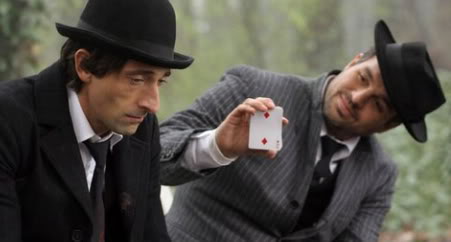
When making a movie about major cons, it helps to have Ricky Jay‘s involvement, which bestows upon the project a tacit endorsement. And so The Brothers Bloom begins with Jay’s voice, narrating the headlong tale of the titular characters’ boyhood chicanery. Stephen and Bloom, foster home vagabonds, discover a latent talent for identifying and exploiting dupes, an epiphany that unlocks Stephen’s artistry and begins brewing Bloom’s guilt. Years later, the brothers have achieved a certain level of fame for their cons and matters have come to a head. Stephen dream of the one great con, and continually needs to pull Bloom back to their lives’ work. The fabled “one last job” emerges when Stephen realizes he’s found the perfect mark in an obscenely wealthy woman with quirky reservoirs of expertise, but street smarts thoroughly blunted by a lifetime locked away in her New Jersey mansion.
The Brothers Bloom is writer-director Rian Johnson’s follow-up to his marvelous debut, Brick. It shares with its predecessor a relentless inventiveness, a seemingly endless supply of smart, witty dialogue, and a level of conviction that ensures the film avoid the pitfalls built into its somewhat gimmicky premise. Bloom isn’t as lean and shrewd as Brick, but it boasts a newfound visual creativity that is vividly alive. Johnson is making a sort of caper movie, built upon the rhythms of classic Hollywood screwball comedy, awash in charm and flinty insight. The tumblers of the plot don’t always click into place as cleanly as they could, but Johnson has built in a conceit that makes those little rough wrinkles almost beside the point. Stephen is the architect of the cons, and he views them as sprawling works of art, performance art with an illicit payday. He builds in allusions, plays with themes, develops motifs, and the movie that houses his cons follows this blueprint. The particulars of the storyline are generally sound, but ultimately secondary to the ideas Johnson is playing with: the pliability of identity, the difficulty in defining one’s own needs and desires, and the allure of storytelling itself. If the movie’s narrative occasionally gets a little soft, it’s always in service to Johnson’s playful exploration of concepts like these.
Mark Ruffalo and Adrien Brody play the scamming siblings with admirable skill, but the clearest thievery is perpetrated by a pair of actresses, each stealing scenes with abandon. Rinko Kikuchi is nearly silent in her portrayal of henchwoman Bang Bang, but builds a full, vibrant character out of reactions, body language and an oddly engaging wry disaffection as she surveys the interplay of everyone else. Even better is Rachel Weisz as the targeted heiress. As a sheltered woman embroiled in the first adventure she’s ever had after a lifetime at playacting at them through the accumulation of offbeat skills, Weisz has to play a mix of innocence and intelligence, signaling her character’s emergence into a warped world that makes a little more sense because she has no cause to evaluate it with a cynic’s deduction. It’s a performance flavored with zingy joy, a perfect representation, it turns out, to the pleasure of watching a richly layered, wildly engaging movie play out. The Brothers Bloom may not be as transcendent as that, but it comes blessedly close.
(Posted simultaneously to “Jelly-Town!”)
Discover more from Coffee for Two
Subscribe to get the latest posts sent to your email.
 Coffee for Two
One thought on “We question everything we see, when someone’s talking there’s nothing to believe”