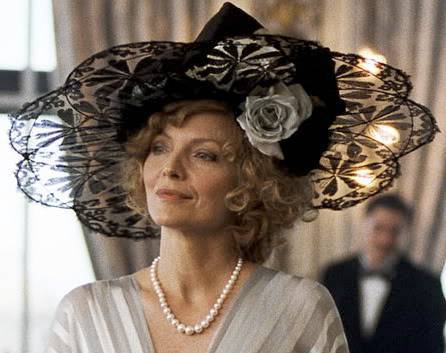
Recently I saw an interview with Michelle Pfeiffer on a morning talk show, the sort of place where informed discourse goes to die. Amidst the general harmless banter that Pfeiffer was clearly tolerating rather than enjoying, there came a point that required her to explain to the journalist sitting across from her that her new film Cheri is not actually a sequel to Dangerous Liaisons. She did so with gracious patience, but it was clearly a question she’d grown tired of, undoubtedly caused by addressing it repeatedly throughout the press junket to promote the film. Just a little homework would tell anyone that that, despite the ability to slap the “period piece” tag on both, two films have no characters in common and, in fact, take place over a hundred years apart, Liaisons being based on an 18th century novel and Cheri requiring the art directors to secure some vintage motorcars for the first part of the 20th century. The misunderstanding arises from the fact that Cheri is a mini-reunion, bringing Pfeiffer back together with director Stephen Frears and screenwriter Christopher Hampton of the earlier film. (In between the two films, Frears and Hampton worked together on one other occasion, that also happened to involved Liaisons cast members, but there’s been little to no talk of that offering. The invocation of Liaisons is a sort of wishful thinking, a hope that this new film might capture some of its cunning and ingenuity. It’s fruitless. Cheri is a flavorless affair.
Set in the waning days of The Belle Epoque, Cheri casts Pfeiffer as a retired courtesan, living lavishly off the riches she amassed during her career, when she was renowned as one of the most beautiful women in Paris. She takes the disaffected, morosely decadent young son of one of her rivals as a lover. Initially she sees the affair as disposable, one of many she’s indulged in over the years. Instead, as she begins to lose him, she discovers it has blossomed into a love she’s not not certain she can do without. The central problem is simple: the love affair is completely uninvolving. There are basic, understandable reasons why the relationship would have slipped from indulgence to captivation, such as the simple duration of it before the young man’s mother arranges a marriage that takes him away. The hold these two have on each other can be reasoned out logically from the information delivered through exposition and narration. You can see it, but you can’t feel it, an absolute necessity for this sort of film.
There are still bits that work reasonably well. As might be expected, all of the art direction and costume design is exquisite, and Frears remains a quietly assured director in the pure mechanics of visual storytelling. When the film turns its attention to the passive aggressive verbal jousting that occurs between the courtesans past their prime, it gets a little devilish spark that may not bring it to life, but at least gets it groggily fluttering its eyes. Then there’s Pfeiffer, who plays the key moments with smashing authority even if she can’t quite get past the the inherent problem of a character largely defined by an onscreen relationship that is dramatically flat. In general, Michelle Pfeiffer has has some difficulty establishing her place in the cinematic landscape since returning from the five year layoff she took after 2002’s underrated White Oleander. Like the broader character roles she’s taken on, this isn’t really the solution, but there are reminders in the best sequences, in the tart edges, in the striking closing shot, of the rewards that will come when she does fully find her way back.
(Posted simultaneously to “Jelly-Town!”)
Discover more from Coffee for Two
Subscribe to get the latest posts sent to your email.
 Coffee for Two