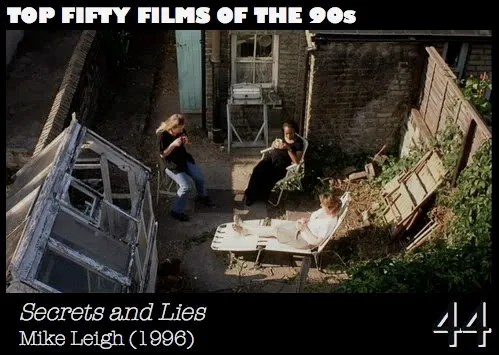
#44 — Secrets and Lies (Mike Leigh, 1996)
It is a film about little lives, the sorts that are easy to bypass, assuming that the stories they hold are entirely unremarkable, that they hold no surprises, nothing worth measuring up against the whole of human experience to discover something true and unifying. To say they are lives lived at the fringe implies too much low glamor, a sort of tattered romance of the outsider that doesn’t really apply. Instead, these are lives lived at the center, overlooked in their toil and ache, routinely bypassed by most storytellers on their way to high drama or low comedy. It is their resolutely ordinary nature that make their heartaches and victories all the more poignant. And when something truly unexpected happens, entire reserves of emotion, trained into hiding by years of disappointment, can be unlocked.
Building the characters and storyline in his usual collaborative fashion, Mike Leigh delivers Secrets and Lies with a compelling empathy. At times, Leigh’s style can let things veer too closely to caricature, the actors layering on detail and color until a recognizable person is entirely obscured. That danger exists here, particularly with Cynthia Purley, played by Brenda Blethyn. She exhibits a mix of sadness and neediness so potent that it practically sets her insides trembling, her voice extending the word “sweetheart” with such creakiness that it almost sounds as if it’s being spoken through a spinning fan. She is broadly drawn, but the care Blethyn brings to the role and the restraint Leigh brings to how her story is told work in tandem to make certain that she is never held up for cruel ridicule. Instead, she commands our sympathies as she inches towards the possibility of some sliver of happiness, or at least newfound contentment, that has long been fully beyond her reach.
Belthyn’s performance is striking in its uniqueness, but it shouldn’t obscure the other exemplary work across the cast, especially Marianne Jean-Baptiste and Leigh stalwart Timothy Spall. Working together, they dig deep to show just how hidden histories can feel like betrayals when they’re revealed. More hopefully, they also delicately portray the ways in which the bonds of family, even those pulled together through unconventional means–maybe especially those pulled together through unconventional means–have a tremendous healing power. No matter how harsh the dilemma, how heated the words, there’s always a way out, always a route that can lead to fresh understanding. Mike Leigh explores this with care, with patience. There is wrenching drama, but it plays out in an understated way. Leigh is after something real, not the sort of manipulative sucker punches that too often characterize cinematic family dramas. He knows that condensing lives down to a two-hour movie doesn’t automatically necessitate amping up the emotion. It’s by keeping it honest, by letting scenes play out with the most genuine reactions that can be mustered, as if the camera was surreptitiously placed in the corner of a flat’s kitchen just before a group of people encountered some of their toughest moments, that Mike Leigh turns filmmaking into an ongoing act of discovery.
(Posted simultaneously to “Jelly-Town!”)
Discover more from Coffee for Two
Subscribe to get the latest posts sent to your email.
 Coffee for Two