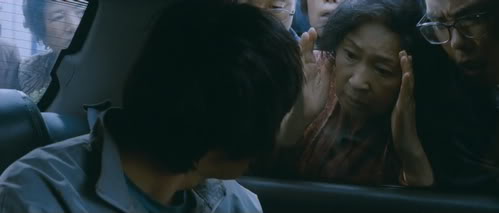
Writer-director Bong Joon-ho’s follow-up to the splendid creature feature The Host finds him moving from the realm of Ishiro Honda to that of Alfred Hitchcock. It could be argued that he’s still tracking monsters and assessing the damage that they leave behind, although terming the central characters of the film Mother monsters is a stretch of the cinematic application of the word. In movies, human perpetrators of tragedy can deliver their devastation with a far twistier cruelty that in on display in Bong’s film. Indeed, one of the many strengths of Mother is the way that Bong collaborates with Park Eun-kyo to build a screenplay that makes the actions of the characters understandable, even as they are less and less likely to inspire sympathy.
The film is about a mother and son. He is slow-witted, interacting somewhat carelessly with the rest of society. He stumbles into situations and forgets the most pertinent details of his actions almost immediately. His mother, understandably, is protective and cautious, keeping a keen eye always turned his way, even as it occasionally contributes to her own personal peril, a dynamic established in the very first scene as she watches him fumble around with a dog on a busy street, oblivious to the guillotine blade slicing down near her fingers while she cuts dried herbs. She is compelled to protect him from a world that is, at best, indifferent to his shortcomings. As the film progresses, suspicion rises that perhaps she has some cause to equally protect the world from him.
This matriarch is played by Kim Hye-ja with a quiet intensity. Her character’s journey is marked by regularly arriving mileposts of revelations. Each invites actorly bursts of emotion. Instead, Kim primarily responds by constricting, pulling within herself. As a result, her performance is even more wrenching, as she tightens, regroups and begins anew to figure out her problems of increasing complication. This is one of the areas where Bong most clearly emulates the masterful Hitchcock. He develops the suspense out of the psychology of the characters, particularly as they relate to one another.
The other way is with his endlessly creative images. His construction relentlessly displays a bravura inventiveness, a willingness, a compulsion to find visual loveliness, even sometimes in the most mundane of shots. This isn’t the sort of overly refined design that occasionally smothers the work of similar practitioners of precision filmmaking like Wes Anderson or Sam Mendes. He doesn’t sacrifice earthiness, spontaneity, the rewarding snap of unpredictability in the name of creating rectangles of art a frame at a time. Mother always feels fiercely, toughly alive, even as the elegance of the frame continually reminds that it is a film shot by a man with a remarkable eye.
Discover more from Coffee for Two
Subscribe to get the latest posts sent to your email.
 Coffee for Two