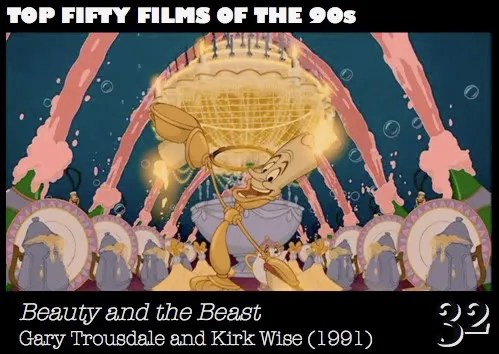
#32 — Beauty and the Beast (Gary Trousdale and Kirk Wise, 1991)
The nineties were a good decade for Disney animation, an outcome that seemed highly unlikely before the release of 1989’s The Little Mermaid and far from certain after it. Mermaid resurrected the Disney brand after a moribund stretch that found the studio faltering with middling efforts that had none of the assertion of classic entertainment that made the animation arm of the company a totally unique juggernaut back in Walt’s day. The follow-up was a sequel to 1977’s The Rescuers, an effort that was only a modest success, both in terms of box office and artistic merit. It wasn’t clear if Mermaid was the opening salvo to a new era of animated wonders, or merely an aberration as the company keep trudging further along towards insignificance. Turns out it was a warm-up to arguably the most rewarding and productive stretch the company had seen since the inaugural years of Disney feature animation when Snow White and the Seven Dwarfs, Pinocchio, Fantasia, Dumbo and Bambi came out in succession in an amazing five-year span. The film that truly ushered in this second Golden Age still stands as one of the finest achievements of the studio.
Like many Disney animated classics, Beauty and the Beast is based on a fairy tale. This time, however, directors Gary Trousdale and Kirk Wise conspire with screenwriter Linda Woolverton (and a whole fleet of individuals who share story credit) to cannily invert all of the tropes that Disney spent decades establishing. The “princess” is a bookworm who’s repulsed by the advances made the square-jawed gent who aspire to the station of a charming prince. The traditional anthropomorphic animals are replaced by sentient bric-a-brac in the castle of the titular beast, an utterly reasonable extension of the same enchantment that caused his furry, brutish appearance. There’s never much doubt regarding the ultimate outcome of it all, but the inversions and embellishments created by the filmmakers give the film a radiant immediacy. By bending the conventions of fairy tales–Disneyfied fairy tales in particular–they heighten the emotions of the work to something beyond storybook, something that approaches operatic heights of divine splendor.
This still isn’t the element that stands as Beauty and the Beast‘s finest. That distinction belongs to the splendid song score crafted by the team of Alan Menken and Howard Ashman, the same pair whose work on The Little Mermaid essentially transformed the Disney format from animated films with songs to inspired musicals that happened to be hashed out in pencil and ink. Menken’s music is unerringly lovely and exuberant, and Ashman’s lyrics stand as vibrant testimonies of wordsmith genius, perfectly capturing the inner workings of different characters while also properly setting the mood and driving along the story. It takes a special lyricist to come up with a couplet like “Try the gray stuff, it’s delicious/Don’t believe me? Ask the dishes” and have it be something more that a cute rhyme, instead standing as a succinct, ideal encapsulation of a moment of offhand magic.
That sort of magic is precisely what’s promised every time the twinkling light arcs above Cinderella’s castle to introduce a new Disney animated feature, a film with the word “classic” automatically, presumptively added to it. With Beauty and the Beast, perhaps as much as any other film every issued by the studio, they fulfill that weighty promise.
Discover more from Coffee for Two
Subscribe to get the latest posts sent to your email.
 Coffee for Two