The more fantastical a movie is, the more likely it will be heaped with praise for the vivid realization of its setting. Whether it’s Peter Jackson’s J.R.R. Tolkien adaptations, the Wachowski brothers’ plunge through payphone lines to reach the Matrix, or any one of Christopher Nolan’s tweaks of the possible, the ability to realize a fictional landscape–to build a world–is usually only considered within the context of cinema that aspires to some level of pure fantasy. But that quality is just as important in works that are grounded in more recognizable places and experiences, like the sort of insular societies that are as close as a wrong turn on a rural highway.
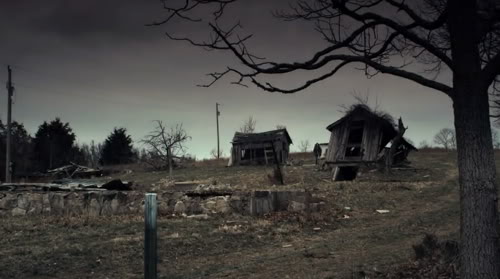
Writer-director Debra Granik’s second film is Winter’s Bone, an adaptation of a novel by Daniel Woodrell. The plot is fairly simple. A seventeen-year-old girl cares for her two younger siblings and mentally withdrawn mother on the humble family property in the Missouri Ozarks. She discovers that her errant father used the land to post bond when arrested on drug charges. He misses his court date, giving the young woman just a few days to either track him down or prove he’s deceased in order to prevent the authorities from taking away the only thing of worth held by her and her family. The film is structured as a mystery as she climbs out to the tangled branches of the family tree seeking insight on her father’s whereabouts, but it is not reliant on the jolts and revelations typical of such stories. When the solution eventually arrives, as it must in fiction, it does so as a result of her persistence rather than her sleuthing. What makes Winter’s Bone gripping and persuasive is its extraordinary sense of place.
Among these people who have intentionally kept themselves apart from the hustling nonsense that exists outside their familiar woods, there are strict protocols of interaction and fiercely enforced pacts of privacy. This isn’t clear because some character explains it, laying out the particulars for a convenient stranger in need of an education. It’s clear because of the way Granik casually immerses her story in the culture of the hills. There’s a formality dependent on the strict, understood borders. With it comes a constant haze of threat. Fortunes can turn at any moment. As she did in her fine debut, Down to the Bone, Granik adds authenticity to the work with this commitment to unadorned accuracy. And, as she also did in her debut, Granik has partnered with her little-known leading actress to help her develop a deeply felt performance built on moments that are quietly shattering. Jennifer Lawrence is excellent as the teenager burdened with keeping her family safe, playing scenes of fragile desperation with an understated grace.
Granik is listed as screenwriter along with Anne Rosellini, but dedicated watchers of the closing credits will see several more names cited for contributing “additional dialogue.” This little band includes cast members in small but pivotal roles, which could help explain why great swaths of the film have a plain, true nature that calls to mind the most straightforward documentaries. There’s a scene in which Lawrence’s character talks to an army recruiter about enlisting only to have him calmly, directly explain all the reasons why it’s probably not a good idea for her. By most measures usually applied to movie scenes, it’s nothing special, but its couple of minutes exemplifies everything I admire and adore about Winter’s Bone. It demonstrates a sort of fearlessness, specifically a confidence that a narrative can be built on spare clarity. Winter’s Bone doesn’t get its power from charging at the audience. Like the most menacing characters within its frames, the film is most imposing when it’s at its stillest. The storm will come, and the gathering clouds are warning enough.
Discover more from Coffee for Two
Subscribe to get the latest posts sent to your email.
 Coffee for Two