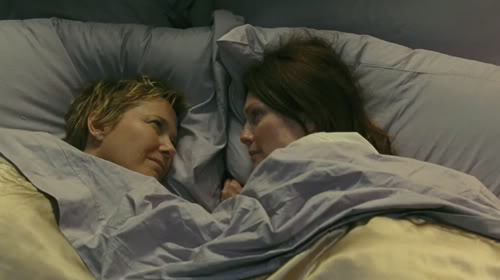
The thing about out-of-the-ordinary family structures is that they’re typically not odd to the people existing within them. Certainly being outside the norm of society’s rigid (but loosening) definition of what makes a family can cause some dismay and feelings of otherness, especially when hateful, nonsense-spewing nitwits try to make any “lifestyle” that doesn’t meet with their approval the battered ball in an endless political soccer match. But day-to-day in a house, in a home, the challenges of being a part of any family are simultaneously unique and universal. It might be trying, infuriating, heartbreaking, rewarding, moving or amusing, but, no matter what it looks like from the outside, for those living through it, it is rarely weird. That’s arguably the point of Lisa Cholodenko’s new film The Kids Are All Right. It’s definitely its greatest strength.
The film focuses on a family headed by a lesbian couple, played by Annette Bening and Julianne Moore. They have two children, three years apart, that were each conceived from sperm from the same donor. When the daughter turns eighteen, her brother badgers her into following through on her new legal right to seek out information about their biological father, a man who’d been nothing but a theoretical figure throughout their lives. In short order they find him, conveniently still living nearby. He’s an organic gardener and restaurateur, played by Mark Ruffalo as a self-made social outlier who’s been working hard to make sure becoming a professional doesn’t necessarily mean growing up. He’s brought into the shared life of this existing, functioning family unit, and how his presence and his actions tilt the dynamic is what drives the story.
In a way, the film operates as a well-populated character study. There are definitely story threads to follow, and it all progresses in fine enough fashion, but Cholodenko’s expertise is in the details. For one thing, she gets fights just right. She knows how they move and shift, how harsh words inspire harsher words, and how angry conversations escalate to the point where walking things back is impossible. Finding a new way to move forward is the only recourse. That’s just the fiercest example of a interpersonal veracity that infuses the entire film. The conversations between the family members feel like they were eavesdropped upon instead of created, and they always unfold shaded by the context of the moment. The flare-ups aren’t empty drama shoved in sideways to the proceedings; they’re properly reflective of whatever the characters are going through, whether the pending departure of a child to college or a revelation that threatens to shatter a long-cherished partnership. All of these moments are given added authority by the actors, especially Annette Bening, who leaves behind the affectations that often show up in her work (sometimes to good effect, sometimes to ill) and is as natural and relaxed as I’ve ever seen her. Her level honesty has a piercing effect.
The family in The Kids Are All Right faces challenges that aren’t shared by many others, but every aspect of the film is built around the mandate to make sure what’s onscreen is still recognizable. People and challenges that skew fragile balances comes in many forms, after all. It doesn’t need to be a long-forgotten fellow who chose a different donation route than plasma to earn a little money who knocks on the door to make it seem like an interloper has arrived. The beauty of Cholodenko’s movie is that it holds within its frames the resolve that every story is different, but emotional landscapes are awfully similar, no matter how the family is built.
Discover more from Coffee for Two
Subscribe to get the latest posts sent to your email.
 Coffee for Two