Let Me In is based on the novel Let the Right One In (or Låt den rätte komma in, if you prefer), but it’s probably more accurate to say it’s based on the Swedish film adaptation written by the book’s original author, John Ajvide Lindqvist, and directed by Tomas Alfredson. It’s a debt that’s openly acknowledged, including a special citation in the the credits. It’s also unavoidable. The original film version has a spirited cult following and earned critical praise well beyond that usually afforded to entertainments centered on supernatural creatures spilling a lot of blood. Writer-director Matt Reeves had a daunting task in front of him, made all the more difficult by a battalion of opinionated souls standing at the ready to cry foul at any deviations that smacked of making the fearlessly grim storyline more palatable to American audiences. Reeves repeatedly professed his great admiration for Alfredson’s film, and his intent to honor it properly. It’s one thing to say it, it’s another thing to do it. Reeves has done it.
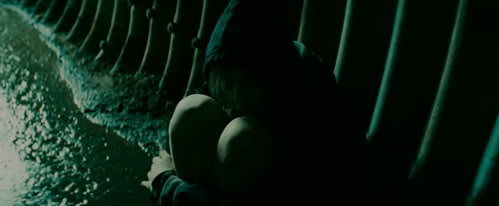
The film focuses on an unhappy young boy, played here by Kodi Smit-McPhee. He’s bullied in school, and suffers at home as the largely forgotten victim as his parents spar their way through a messy divorce. His only pleasure comes from sitting on the monkey bars in the snowy courtyard of his apartment complex, singing quietly to himself as he munches away on secretly procured candy. Things start to shift for him with the arrival of a new neighbor who appears to be a girl right around his age. That perception is both right and wrong, and as he becomes more entangled with her, the secrets emerge.
The first film makes brilliant use of the chill of the Swedish winter, making the whole world feel as if its been frozen over. Reeves transplants the story to the same season in Los Alamos, New Mexico, a shift that works remarkably well. Seeing this place that typically resides in the mind as a desert barren enough to assemble and set off an atomic bomb or two under a smothering coat of snow actually makes the isolation of the winter more pronounced. The frigid cinematography of Greig Fraser, which makes several scenes look as though they’re shot through a layer of permafrost, drive this home further. Reeves also gets traction by emphasizes that the film is set in 1983. There’s no cell phones, no online communities. These kids are completely on their own, and unless they find one another, they’re likely to drift that way forever.
Maybe the only concession to the more agitated palate of U.S. horror audiences is the inclusion of some CGI, which isn’t bad in and of itself. The problem arises because the CGI is quite poor, making it a dismaying distraction in the admittedly infrequent instances it crops up. It’s also entirely unnecessary. The film creates its chills through mood as much as anything else. Wildly kinetic acrobatics is the last thing it needs, but that’s precisely what Reeves adds to the mix, as if it’s necessary to provide proof of the metaphysics afoot. That doesn’t come from technical heavy lifting, it comes from the conviction of performance, and Chloe Moretz acquits herself quite well as the inhuman pal. She doesn’t have the same level of looming danger as Lina Leandersson, her predecessor in the role, but she taps into a different sort of sadness, a deeper evocation of the ache that arises with an endless lifetime of tragic need.
It’s difficult to separate Let Me In from its context. Is it arriving too soon after Let the Right One In‘s appearance in U.S. theaters, just two years ago? Does it adhere too closely to the vision of Tomas Alfredson, giving it the feel of a story retold instead of its own piece of work? These considerations are less about the film itself and more about the reasoning behind it. They remain worthwhile questions, but I think they ultimately matter less than what’s up on the screen, measured only against itself. Under those terms, it’s a grand success. And truthfully it’s good enough that even the long shadow cast by Let the Right One In doesn’t obscure it.
Discover more from Coffee for Two
Subscribe to get the latest posts sent to your email.
 Coffee for Two
2 thoughts on “There’s a peacefulness and a rage inside us all”