I’ll readily concede that this is a minority opinion, but I don’t think David Fincher was really a filmmaker who merited serious attention until 2007’s Zodiac. He was a formidable stylist and his impact and influence were mutually significant. The movies themselves, however, were severely lacking. His work was about pristine surfaces and overly precise compositions, sleek exercises in ocular beauty that regarded the intricacies of human emotion with, at best, disinterest. It may be a glib and overly reductive criticism to proffer, but it’s also fitting to say that Fincher made movies like a music video director. That makes sense, of course, given that’s how Fincher made his name. Lovely as the screen often looked, even when Fincher was depicting something grotesque or otherwise gnarly, there was an emptiness so pronounced it almost echoed. Zodiac turned that around without compromising Fincher’s visual adeptness. It was as if the reality of that story, the embedded obligation to honor the individuals who lived the tale, imposed some discipline on him. If the return to pure fiction with his dreadful follow-up fortified my theory, then The Social Network may stand as the compelling closing argument.
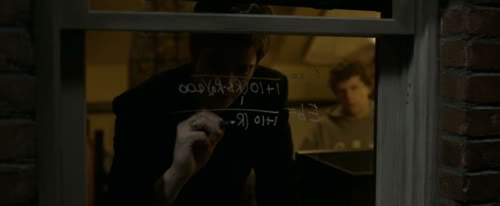
Like Zodiac, Fincher’s latest is based on true events, specifically the creation of Facebook and the litigious battles that followed. Jesse Eisenberg plays Mark Zuckerberg, the Harvard student and coding whiz who built the site from the beery comfort of his dorm room. Unfortunately for him, he built it after talking to some fellow students about a similar project, leading to major conflicts as the initially exclusive Internet stopover built and built in popularity, its value skyrocketing in accordance with the enormous number of users joining up every moment. Aaron Sorkin’s screenplay tracks this meticulously, using Ben Mezrich’s book The Accidental Billionaires as a road map. The film alternates between testimony around the mediation table and depictions of the site’s development and the charges, counter-charges and different betrayal that bubbled up throughout the process.
The accuracy of the story is somewhat in dispute, an inevitable pitfall when relaying the details of something so contentious. That’s not much of a concern, though. The filmmakers are trying to create drama, not argue their own case like some Charles Ferguson documentary. They’re more interested in character, and the events they depict are primarily useful for the way they reveal different shadings in the people driving and enduring them. The film is about those who crave status, and those who have grown so accustomed to their privileged good fortune that they’re apoplectic any time the world doesn’t spin their way.
The film is naturally most fascinated with Zuckerberg. He emerges as a endlessly fascinating figure, longing for the validation that comes from penetrating the elusive hierarchy of Harvard’s social scene while simultaneously heaping disdain on it. His achievements are fueled by resentments and animosity that he stores in his memory with an elephantine permanence. His every relationship is marked by awkwardness and impatience, making it seem like he’s at his most content tapping away at his laptop, eyes riveted on the screen and bulky headphones blocking out the input of others. The film circles joyously round the irony of a social malcontent crafting a paragon of new media personal connectivity. It’s no minor detail that Zuckerberg’s realization that profile pages need a “Relationship Status” line is treated with the importance of Marie Curie finally isolating radium. Understanding relationships of any sort seems to be entirely outside of his significant mental range.
Eisenberg is tremendous in the role, smartly playing Zuckerberg and driven and pathologically focused rather than some villain. He’s not just an outsider, he’s genuinely perplexed by the culture he observes, and therefore easily susceptible to anyone who seems to be speaking his language. Eisenberg is particularly skilled with Sorkin’s jazzy drumbeat dialogue. The movie begins with a scene that practically plays as a parody of Sorkin’s racing interplay, as Zuckerberg jousts with with his girlfriend, played by Rooney Mara. Eisenberg immediately reveals himself to be the actor of the distinctive writer’s dreams, making the distracted, proudly unnatural dialogue sound both affected and yet real as can be. It takes the pressure off of the other actors, letting them play the emotions rather than nail the words. If Eisenberg’s Zuckerberg is the brains and mouth of the movie, then Andrew Garfield’s Eduardo Saverin is its affecting heart. He’s the one true friend that Zuckerberg has, the guy who first ponies up the dough to get Facebook off the ground, and the first to be discarded when it starts to flourish. Garfield is always perfectly in the moment, signaling the conflicted feelings of his character as the earth shifts beneath his feet. The one problem in the cast is Justin Timberlake as Napster creator Sean Parker, who becomes a predatory mentor to Zuckerberg. It’s a pivotal role that requires a skilled actor, not a moonlighting superstar. Timberlake doesn’t embarrass himself, but he doesn’t have the chops for it either.
Fincher takes a sharp, insightful approach to the material. He still can’t quite resist a juicy, “notice me” type of moment–a misty-lensed, arty boat race sequence sticks out–but for the most part he shows how creative shot construction can be used to serve the story instead of obscure it. His masterful technical acumen merges with an film artist’s eye. He knows blocking and lighting and post-production polish. Increasingly, he’s demonstrating similar skill with probing for the right emotional beats within a scene. Facebook may be about giving people a tool to connect, but The Social Network is about all the ways they don’t. Fincher’s most unexpected triumph is making that absence as tangible as anything that actually makes it to the screen.
Discover more from Coffee for Two
Subscribe to get the latest posts sent to your email.
 Coffee for Two
4 thoughts on “Used to be one of the rotten ones and I liked you for that”