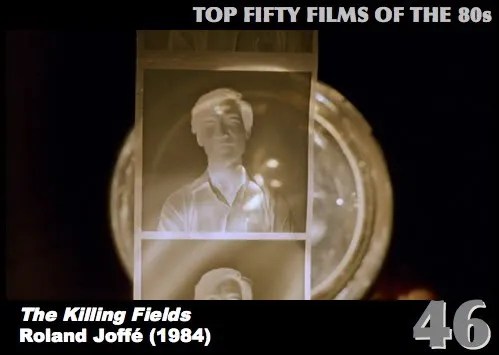
#46 — The Killing Fields (Roland Joffé, 1984)
One of the unfortunate tendencies of filmmakers centering their art on foreign cultures or besieged minorities is a default towards protagonists who stand outside of the group being depicted, with a particular preference for some sort of noble white hero. There are many basic, purely logistical, relatively benign reasons for this. Like audience members, filmmakers benefit from having a character they can relate to driving the story, and an outsider looking in mirrors the probable experience of those writing the script and choosing the shots. The parallels are even more pronounced if that lead role is journalist of some sort, which happened with remarkable regularity in the docudramas of the eighties. There’s a similar occupational imperative to collect information and dispense it in a clear, engaging, informative manner. The real test of a filmmaker is whether they use that method as little more than a short cut to telling a complicated story, or if they have the nerve to make every bit of the movie vital and worthwhile.
Roland Joffé’s The Killing Fields is about the stretch of time when the Khmer Rouge took over Cambodia, with special attention paid to a group of journalists who try to extract one of their colleagues, a native who they’re certain will be oppressed under the new regime. Played by Haing S. Ngor with the stolid perseverance of an individual with keen understanding of the way history can invade a life, extracting a terrible, nonnegotiable cost, Dith Pran is central to the film, even as much of it dwells on the experiences of his friends in the foreign press, notably the New York Times reporter Sydney Schanberg, played by Sam Waterston. Syndey relies on Pran’s local connection to develop his stories and is at the lead of the collective effort to win Pran freedom from the new totalitarian rule, and effort that eventually fails. Sydney and his colleagues return to their various homes to collect acclaim and awards for their work while Pran is forced into hard labor. It’s to the film’s credit that the guilt that arises from this development is as firmly depicted as anything else.
Screenwriter David Putnam and director Roland Joffé bring their own aspirations towards journalistic verisimilitude to the the film. At the of the film’s release, in 1984, the events depicted on screen were of a relatively recent vintage, meaning there was additional incentive to honor the real people who lived the story by disregarding any temptation to treat it sensationally or otherwise compromising the honesty of the story. Instead, it’s beholden on Joffé to develop his drama from the little details that would proven harrowing for those in the midst of it all. There may be nothing more gripping in the film than the seemingly mundane task of developing a photograph. It’s needed to create a document that should allow Pran to leave, but the right equipment and chemicals aren’t on hand, leading to creative problem solving and ad hoc solutions that ultimately prove fruitless. The process of these men repeatedly attempting to complete this act that would be simplicity itself under other circumstances, the free life of their friend dependent on their success, is as intensely thrilling as any of the adrenaline goosing mayhem in an action movie, precisely because Joffé has made the consequences so understandable and so real. The Killing Fields doesn’t operate in the abstract of distant observation, a state almost invariably tinged with an inadvertent condescension. Instead, the movie is immersed in the troubling moment in time it depicts, properly giving voice to all involved.
Discover more from Coffee for Two
Subscribe to get the latest posts sent to your email.
 Coffee for Two