Take any minute or two of Lesley Manville’s performance in Another Year and strip it of all context. Even in total isolation, it would be immediately recognizable as a character from a Mike Leigh film. She exhibits a haggardness so entrenched in her very being that it’s easier to conceive of it as an inborn condition than as a result of a hard life. Her voice wavers with uncertainty and need, every line becoming a exercise in conjuring up an otherworldly anti-melody. Her enthusiasm is constantly thwarted, leaving her staring into the distance with a shell-shocked disappointment, seemingly calculating all the awkward tragedy he’s pulled down upon her. She’s a recognizable cousin of Brenda Blethyn’s Cynthia Purley in 1996’s Secrets & Lies or Jane Horrocks’ Nicola in 1991’s Life is Sweet, a character built with a tremulous soul to better express the ways she’s been knocked out of step by an uncaring, nearly unnavigable world. While distinctiveness is welcome in a filmmaker, it can also become a curse. All through Mike Leigh’s latest film, I kept struggling with the unwelcome feeling that I knew this character too well, that I’d seen this character too often.
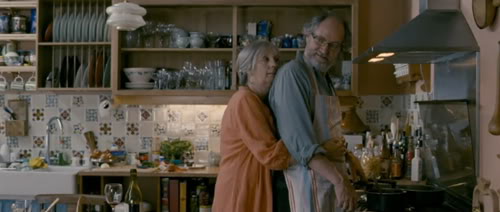
That proved to be an especially unfortunate distraction since much of Another Year is quite wonderful. The central characters are a married couple named Tom and Gerri, played by Jim Broadbent and Ruth Sheen, and Leigh collaborates with his actors to craft remarkable compelling scenes around little more than a portrait of their fairly tranquil domesticity. They garden and discuss their respective days and occasionally entertain friends, many of whom have a tendency to imbibe a little too much. The drama is all fairly muted. It is, as the title promises, just another year in these intersecting lives. Relationships shift, develop and are marked by little ruptures. The film is about how these people get along through it all.
It’s also about the divide between the central couple and those in their orbit. Broadbent’s character is a geological engineer and Sheen’s is a counselor at a medical facility. They are clearly well-read and openly curious about the world. They have strong reserves of knowledge, sturdy sensibilities and a capability to communicate their ideas clearly. It’s not necessarily that they have grander aspirations that anyone around them, but they approach their existence with a sort of contended comfort. The things they yearn for are simple and achievable with no especially burdensome impact or cataclysmic outcome if they don’t come to pass. Decent and modest, they’ve avoided the sort of yearning emptiness that plagues many of their friends, acquaintances and relations. The best sequence of the film involves the interactions with Tom’s brother Ronnie, who is practically the polar opposite of Tom, a void to his sibling’s abundance. Without overplaying it, Leigh taps into the delicate tenderness and understanding that can exist between vastly different people united by their shared history, and seeing how Ronnie simultaneously exists within and completely outside of Tom’s sphere approaches the profound. Oliver Maltman plays Ronnie with a necessary absence of overt emotions and still conveys a strong sense of the man.
This is the sort of subtlety that suits Leigh best. When he allows his material to get too broad, little hints of judgment start to creep in. Tom’s good friend Ken, played by Peter Wight, is a lumbering wreck, but outfitting him in a juvenile t-shirt that touts the superiority of drinking to thinking is a bit much. It shifts him from a character deserving of sympathy to one held up for ridicule. Leigh’s famed way of working with his actors–giving them extensive leeway to build the characters and letting through well-drawn figures then dictate the stories–offers an unique opportunity to showcase the deep reservoirs of human understanding that can be tapped into, a quality that’s present is many places in Another Year. When Leigh’s focus is clear, such as an early scene featuring Imelda Staunton as a grimly terse patient meeting with Jeri, he takes advantage of that with grand results. Even if there’s some undue and familiar fussiness included throughout, Leigh’s unique commitment to digging for truth carries the film.
Discover more from Coffee for Two
Subscribe to get the latest posts sent to your email.
 Coffee for Two