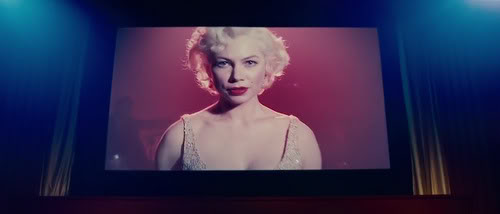
It’s always a unique disappointment to see an excellent performance shellacked into the misery of a bad movie. In the new film My Week with Marilyn, Michelle Williams is consistently sensational as Marilyn Monroe. She’s charged with not only playing a woman with enough mercurial tendencies to make achieving a consistent characterization as difficult as threading a needle in the middle of a blizzard, but also portraying a public figure so well now that she practically defines iconic. It’s been almost fifty years since the woman’s death, and still I’d wager that there’s not a single person who will see My Week that doesn’t go into the viewing with a thorough, embedded impression of what Monroe was like and who she was. This may be the one time in her career that Williams shares a role with a thousand different breathy performers in drag show cabarets.
Indulging in an impression to build the performance upon would have been a reasonable approach, but Williams is thankfully too thoughtful an actress to resort to that tactic, even at points when she’s called upon to duplicate specific onscreen moments of Monroe’s. Williams taps into the mix of vulnerability and charmed confidence that defined Monroe’s onscreen persona. She’s a woman baffled by her own allure, but also fully capable of taking advantage of it as an almost instinctual survival technique. She was a bombshell with enough aspirations to be something more, or at least something different, that kept trying to reinvent herself on the fly even though it brought her nothing but grief from those who hired her to do little more than throw prospective moviegoers into enough of a lustful fervor that they’d plunk down hard-earned dough for any movie she shimmied through. Williams tickle through all those contradictions in her performance while blessedly downplaying the looming tragedy of her tragic life, choosing to focus on Monroe as a person rather than as a symbol for the smothering splendor of success.
Williams often achieves this despite the material she’d given to work with rather than because of it. The screenplay by Adrian Hodges (based on a memoir by Colin Clark that seems highly implausible given the way it’s realized in the film) is wildly unfocused, scrambling up characterizations and bouncing through the plot with a maddening lack of care. The storyline centers on Monroe coming to England to make the film The Prince and the Showgirl with Laurence Olivier. When her problematic behavior–including regularly showing up to the set late and unprepared–begins to cause her trouble, she befriends and then casually romances a low-level crew member named Colin. As played by Eddie Redmayne, there’s absolutely nothing to that character, perhaps the film’s greatest flaw since it’s really his journey being traced. It’s tempting to call him an empty shell, but that falsely gives the impression that there’s anything solid there at all.
Beyond that, the cast is filled with gifted actors who are given little to do. Someone undoubtedly thought it was fitting as can be to give Kenneth Branagh the opportunity to play Olivier, but just because his ever-increasing hamminess is suited for the role doesn’t actually make it any more palatable. As a wardrobe person on the film, Emma Watson suggests that her most significant contribution to the entertainment world following her tenure at Hogwarts will begin and end with showing up at gala events and looking pretty. And a special note of sympathy should be sounded for the great Derek Jacobi who shows up in a fleeting cameo that seems to bore the very life out of him. At least Judi Dench’s turn as Dame Sybil Thorndike offers further support to my theory that she chooses her roles once she’s satisfied that each script includes as least one moment when she can talk to someone as if she’s imperiously appalled by their idiocy.
Director Simon Curtis makes his feature film debut after a busy career in television and flattens what little energy may have been present in the story. The simplest scenes are actually most problematic, suffering from overly rushed editing that cuts preempts moments in conversation like a record player needle skipping a groove. Miraculously, none of the film’s significant problems are mighty enough to do in the performance of Williams, a feat of acting that, it’s worth considering, her Strasberg-taught subject would deeply envy.
Discover more from Coffee for Two
Subscribe to get the latest posts sent to your email.
 Coffee for Two