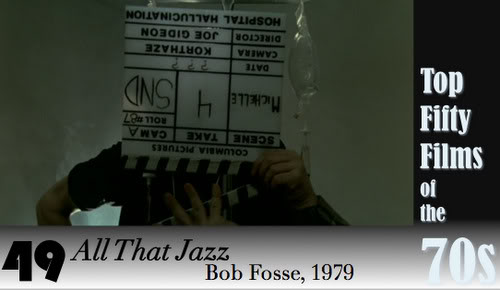
#50 — All That Jazz (Bob Fosse, 1979)
For those trying to determine the half-life it takes for a visionary film director to decay from an award-lauded masterpiece to a wildly indulgent fever dream, the Oscar class of 1972 (or 1973 if you prefer to calculate from the year the trophies were actually doled out) is a handy place to start. That was the year that Francis Ford Coppola’s The Godfather won the Best Picture prize on its way to taking its anointed place among the widely acknowledge Greatest Film Ever Made contenders, but Coppola was actually denied the corresponding Best Director trophy. That went instead to Bob Fosse for Cabaret, the film the probably would have scored the top prize if not for the undeniable value of Coppola’s mob epic (indeed, Cabaret was the big winner of the night by pure mathematics, winning eight Oscars to The Godfather‘s three). By the end of the seventies, both directors had presided over other acclaimed work and were apparently ready to let their creativity run roughshod over any sense of restraint they may have previously felt. Coppola famously drove himself close enough to madness directing Apocalypse Now that his descent was later the subject of the tremendous documentary Hearts of Darkness: A Filmmaker’s Journey. Fosse, on the other hand, didn’t drive himself to a stressful breakdown. He had already done that previously, and that’s dark passage fueled his art.
In this instance, I think Fosse beat Coppola again. While Apocalypse Now is an exercise in artistic catastrophe (I may as well start fessing up to the omitted touchstone films early in this process), Fosse’s All That Jazz is striking vision of a soul collapsing in on itself, the resulting psychological debris manifested in the only manner that makes sense to him. Roy Scheider plays Joe Gideon, a stand-in for Fosse so exact that even the facial hair and wardrobes match. Joe is directing and choreographing a new Broadway show while also completing work on a film, fueling his increasingly weary body with pills, alcohol and other chemical enhancements. Self-destruction is just another art form that he’s mastering. Fosse (who was also credited as co-author of the script, along with Robert Alan Arthur) directs these scenes with the same jaw-dropping kineticism he brought to the angular, highly physical choreography that left his deepest signature. It’s when Joe pushes himself to the brink of death that the film truly careens out of orbit.
His physical and psychological turmoil manifests in visions of full-on showstopping musical numbers as he simmers in agony in his hospital bed, the heart monitor effectively providing time for those figures from his life who snap their tap shoes upon the stage. Movie cameras swoop around as well as Joe has every damaged piece of his personal and professional life convene on a single, largely unadorned theater stage, demonstrating the total opposite of going gently into that good night. This is what “Taps” sounds like when played with jazz hands. All the meta trappings serve to emphasize the film’s position as a bright lights autobiography of the filmmaker, grappling with his own mortality by constructing the shakiest of fictions. Fosse viciously turns himself inside out and then back again and then devotes it to film because that’s frankly the only therapy he understands.
Scheider is amazing in the role, demonstrating a depth and daring he’d never before exhibited, even in very fine performances in some of the seminal films of the decade. The emotional terrain he travels in the role is so grueling that it’s hard not to fear for Scheider’s own well-being, a dissolution of the boundary between actor and part that is, of course, perfectly fitting for the film. He shows how a person can shatter one hairline crack at a time, the entire process as plainly visible as it is unstoppable. And he constructs the character with such ruthless precision that the fact of self-flagellating fantasy as the only retreat comes across as its own form of tragic logic. Fosse leverages that rigorous performance into an jolly evisceration of his own being, particularly the parts of himself susceptible to the damnable siren song of applause. All That Jazz scratches away to find the corrosion behind the razzle dazzle. And that’s showbiz, kid.
Discover more from Coffee for Two
Subscribe to get the latest posts sent to your email.
 Coffee for Two
One thought on “Top Fifty Films of the 70s — Number Forty-Nine”