
From the October 31st, 1981 edition of Billboard:

That’s right. This crap has been going on for ages. I’m honestly sympathetic to the creators who’ve had their viable marketplace chipped away by the ease of sharing copyrighted material, even as I myself have been one of those shifty online perpetrators of questionable distribution of their sonic wares. But then I’m also sympathetic to the ways artists–the ones who actually create the material that I value–has been routinely and systematically fleeced by entertainment conglomerates over the years. Aside from maybe Tom Petty, I’m not sure how many of those artists were particularly sympathetic to me when, say, the record labels were selling CDs at a grotesquely inflated markup, approximately double what they were selling vinyl records for even though the CDs were notably less costly to manufacture.
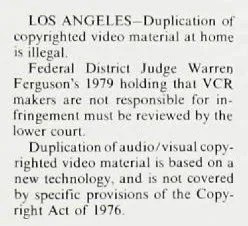
The recording industry railed against radio and the movie industry wailed about television harming them beyond repair. Audio cassettes were the final instrument of destruction and then VCRs were the perpetrators. Apple’s iTunes was going to leave everyone hopelessly impoverished because only one person would buy a song and then share it with the world. Meanwhile, Lady Gaga has annual earnings of around $80 million and the labels do everything they can to squeeze every last meager dime from independent, locally-owned record stores while simultaneously setting up policies that flagrantly favor the big box stores. And we’re supposed to feel bad that the industry is hurting so much that the CEO of Best Buy only made $5 million last year.
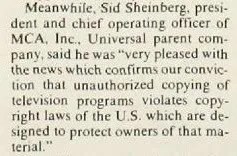
I’m not denying that piracy is legitimate issue, but I’m seen little evidence that the corporate bigwigs have any capability whatsoever of distinguishing between that which is theft and the sort of fair use sharing that could be the greatest array of free promotion imaginable. What’s more, most of the protections they need are already well-covered by the Digital Millennium Copyright Act of 1988, a piece of legislation that was onerous in its own right (and, not coincidentally, often exhibited a basic misunderstanding of how digital communication actually worked) but any lingering infringement has less to do with any loopholes in the law and more to do with the general ineptness of the media overlords to protect the fiefdoms. Or, more accurately, an astounding inability to leverage new delivery resources to their advantage. As others have observed, there are lessons to learn from the recent success of Louis C.K. to self-distribute his latest comedy special via the web, but the big execs are too busy tightly shutting their eyes and jamming their fingers in their ears, shouting nonsense syllables to block out any mention of progress.
As always, instead of adjusting to the shifting landscape, the major media companies have instead decided that they’re at war with their consumers and have dipped into the huge reserve funds they have for lobbying purposes and tried to bully Congress into doing their bidding with SOPA and PIPA. Up to this point, they have largely complied, despite outrage from a wide array of concerned citizens, including significant companies whose backbone is built around web commerce: in other words, companies that actually understand how web-based communications work instead of crusty oligarchs like Rupert Murdoch, who apparently have difficulty putting bread on the table because of the invaluable, ubiquitous services Google provides.
The abusive burden these bills place on users and creators on web-based material is put best by Cory Doctorow of Boing Boing (in a quote I found at another spot) who asserts, “”Boing Boing could never co-exist with a SOPA world: we could not ever link to another website unless we were sure that no links to anything that infringes copyright appeared on that site. So in order to link to a URL on LiveJournal or WordPress or Twitter or Blogspot, we’d have to first confirm that no one had ever made an infringing link, anywhere on that site. Making one link would require checking millions (even tens of millions) of pages, just to be sure that we weren’t in some way impinging on the ability of five Hollywood studios, four multinational record labels, and six global publishers to maximize their profits.” The strictures laid out by the bill are so ludicrous that not even the author of the bill currently meets them.
There is ample testimony out there as to why these bills should be stopped. If you agree, call your representative in the House, call your Senators, call the White House. The residents of my home state have worked tirelessly and are now in the midst of potential proving that, despite all appearances to the contrary, representative democracy is not fundamentally broken. Hopefully, the sensible opponents of SOPA and PIPA, a group I truly believe represents the majority, can do the same.
Discover more from Coffee for Two
Subscribe to get the latest posts sent to your email.
 Coffee for Two
One thought on “Same As It Ever Was”