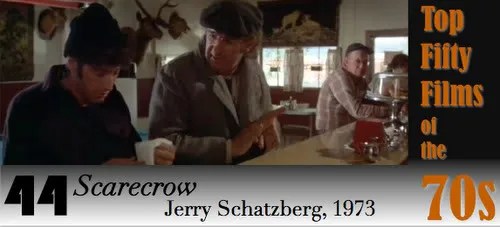
#44 — Scarecrow (Jerry Schatzberg, 1973)
I’m hardly the only person who tends to point to the cinema of the nineteen-seventies as a blessed peak of the art form (conveniently ignoring that for every wonderfully aspirational effort there were plenty of reeking wastebaskets adorned with a studio stamp of endorsement), but I try to recognize that there was nothing magical in the Hollywood water supply at the time. Instead, it was a fortuitous convergence of events, probably led by the arguably overdue abolition of the stifling production code, which, at least for a time, made the active pursuit of art with adult themes a lucrative strategy. There was also the happy significance of a fleet of hungry young performers who spent their formative years in the afterglow of the screen acting revolution led by Marlon Brando and his rough contemporaries a generation earlier. The trail they blazed was now well-worn and comfortable to traverse, and the added ease allowed actors to become even more natural in their embrace of naturalism. Brando was still shoving against the power structure when he murmured his lines, but his direct descendants were settling into a new norm. This led to raw, live wire performances that were heightened in their fabricated sharpness and yet as real as the rising sun.
By the time Scarecrow came out, Gene Hackman had won an Oscar for The French Connection and Al Pacino had become a major star by playing Michael Corleone in The Godfather. Still, it’s probably true to say that neither one was entrenched into the public imagination they way they would be later. They didn’t have established screen personae yet, and, because of this, they arguably had the freedom to go anywhere with the acting, a freedom that wore away gradually but surely, like weather-struck stone. Striking as it may be now to see Hackman without his usual tinge of approachable geniality or Pacino underplaying, emphasizing the gentleness of his character, it’s not the distance from the expected that defines the quality of the performances but the depth of the realization of the characters. The original screenplay by Garry Michael White brings together two lost souls who wind up setting out on journey together, held to their forward motion by fantasies of opening a car wash and the hopeful promise of low-key redemption. Life has been unkind, but there’s a battered belief that the sadness of the past and present can somehow be transformed into a promising, pleasant future.
Jerry Schatzberg directs the film with a sterling empathy. In key moments, he allows the actors to simply work off of one another, favoring long takes with few interruptions or cuts. Hackman and Pacino are charged with carrying the scene, exposing both inner feelings and, more slyly, hidden truths. The movie hinges on the deeper revelation nestled between confessions, the personal that emerges most profoundly when people talk past one another. The film owes a lot to the jagged, combative existentialism of Samuel Beckett, a debt it owns up to in the opening sequence that has the two travelers engage in oblique conversation in proximity to a tree that stands alone, much like the default mode of Waiting for Godot. In Scarecrow, the wait for useful progress is just as futile as it is in Beckett’s signature play. Sometimes the lost stay lost and their efforts to find their way back into the light only plunge them deeper into the gloomy sorrow of the dense woods. As is often the case, the gravest outcome for characters is a boon for actors. The great jackpot of Scarecrow–tying to its era as much or more than any thematic preoccupation of the film–is the presence of actors fully equipped to take full advantage of those possibilities.
Discover more from Coffee for Two
Subscribe to get the latest posts sent to your email.
 Coffee for Two