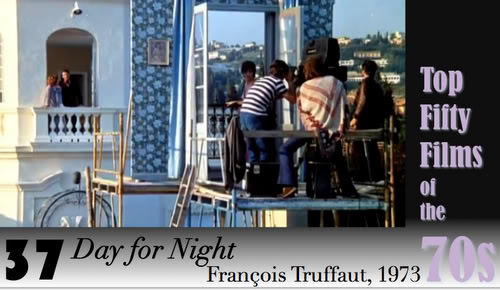
#37 — Day for Night (François Truffaut, 1973)
Auteur theory was first posited in the mid-nineteen-fifties in the pages of Cahiers du cinéma, advocated most persuasively by a young French film critic named François Truffaut. Suggesting the director should be seen as the predominant creator of a film, almost to a degree that he or she can claim total ownership of the art, Truffaut himself became one of the most persuasive pieces of evidence in argument for the viability of the theory when he started making films a few years later. From his debut The 400 Blows on, Truffaut’s films rang with a distinct humanism, a visual rambunctiousness and loving adherence to the well-established narrative mechanics of the form that came together as a vibrant, unmistakable voice. After spending over a decade demonstrating the primacy of the director’s influence through the accumulated artistry of his career, Truffaut slyly presented the counter-argument with Day for Night.
For this film about filmmaking, Truffaut not only directs but steps in the central role, that of a director named Ferrand who’s embarking on a new project entitled Meet Pamela. The cast and crew are assembled in a idyllic location for the shoot, which proceeds as a endless series of miniature melodramas and compromises intended to avert catastrophe. Nearly every person involved with the film carries with them some amount of slippery propensity for existential self-harm. The task of getting the film from conception to finished work is not some generous act of creation presided over by a genius artist, but instead a grinding toil, forever susceptible to the whirling whims of fate, every ill turn simultaneously shocking and wholly predictable as fragile egos collide like pebbles in a rock slide. The director is in the eye of storm but any belief he is controlling its torrents is sadly misguided. In his most confident moments he may view himself as Prospero, bending the winds, but he is conducting a tempest that moves of its own accord. Any synchronicity is pure happenstance.
Truffaut certainly had no reluctance about trafficking in veiled autobiography in his filmmaking so it’s reasonable to read Day for Night as a simple report on the state of his own career in the shifting realm of cinema, inviting speculation on who the star played by Jacqueline Bisset might be based on or which specific film experience might have inspired the director to finally plumb his own profession for a story idea. The deeper pleasure of the film, though, is that it seems to be going for so much more. Instead of looking to his own personal history, Truffaut is presenting a sort of autobiography of the creation process, an exposing of all its myriad wrinkles that can never quite be ironed out. Where he once saw a sort of magic in the authority of the person behind the camera, with Day for Night he concedes the fallibility of the role. Film is a collaborative art and Truffaut exposes all the fissures between the connections.
Discover more from Coffee for Two
Subscribe to get the latest posts sent to your email.
 Coffee for Two