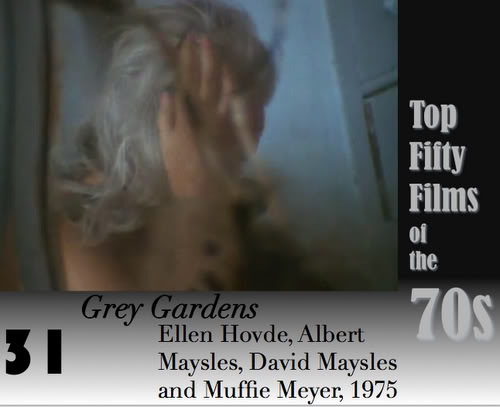
#31 — Grey Gardens (Ellen Hovde, Albert Maysles, David Maysles and Muffie Meyer, 1975)
There are some things in this warped, wild, mixed-up world that outpace even the most fantastic and fanciful of imaginations. Upon discovering such a thing, perhaps the best approach for a documentary filmmaker to take is just point the camera and shoot. Sure, maybe there will be a little prompting, a question here and there. Perhaps there will be the occasional round of verbal sparring with the subject whenever their wavering willingness to be the focus of such scrutiny rears up. For the most part, though, just let the camera roll.
That openness to the totality of the experience is by and large the approach favored by the Maysles brothers, Albert and David. With the film Grey Gardens, they and their collaborators, Ellen Hovde and Muffie Meyer as well as producer Susan Froemke, bring that patient scrutiny to the lives of Edith Ewing Bouvier Beale and her daughter Edith Bouvier Beale, known respectively as Big Edie and Little Edie. The two are former grand socialites who now live in relative decrepitude in a rambling, crumbling house in East Hampton, New York, the sounds of their former glory echoing in their ears, as if the tones of galas and dinner parties are trapped within the domicile, ricocheting from every corner in a vain attempt at blessed escape. During the time that the film takes place, Big Edie is in her seventies and Little Edie is in her fifties, but they cling to former identities as a slightly adversarial mother and child, jockeying for attention in a rarefied society where that is the only real currency.
The Beales first came to national attention a couple years before the release of the film, when various publications wrote about the squalor of their residence, a fascinating topic because of their fairly close proximity on the same family tree as Jacqueline Onassis, hands down the era’s most irresistible figure to the tabloid press (and arguably the legitimate press). In that genesis of their notoriety lies the thematic potency that the film beautifully exploits. The Beales together were the funhouse mirror reflection of the imagined and adopted glamor of the American experience in the years following World War II. Just as the fashion sense, poise and, eventually, dignity of the survivor that characterized Little Edie’s famous cousin was the culture the country aspired to and often felt it lived up in the moments of loveliest self-delusion, Little Edie herself represented the awful truth of the situation, which was becoming more and more apparent as the nineteen-seventies marched on. She was the missed opportunity and the foolhardy perseverance in the face of defeat that had to ring especially true for moviegoers still reeling from the Vietnam War and Watergate. When she strides down the stairs and dances aimlessly but proudly with a miniature American flag…well, the filmmakers couldn’t have asked for anything better.
Despite the slow-motion tragedy of the Beales’ shared lives, the Maysles betray no nasty superiority, no cruel mockery of their subjects. They approach the Beales with a resolute empathy. They don’t mollycoddle them, discreetly turning the camera off, say, when their shenanigans reach the point of supreme embarrassment, but the directors also unfailingly keep the film at the level of pure observation. They effectively live with the Beales and invite viewers to do the same. That commitment surely exposes the ladies’ daffiness, but it also invites an inevitable affection. It’s hard to get so close to people without feeling some level of deeper understanding, an affection for their foibles that overrules any inclination for judgment. With Grey Gardens, the Maysles and their cohorts prove that cinema itself can achieve that sort of closeness, especially when there’s some willingness on the directors’ part to bend the established rules of the form a bit.
Discover more from Coffee for Two
Subscribe to get the latest posts sent to your email.
 Coffee for Two
One thought on “Top Fifty Films of the 70s — Number Thirty-One”