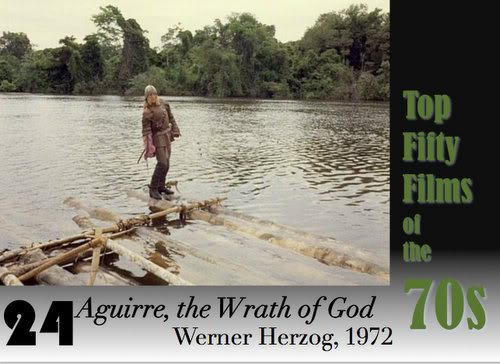
#24 — Aguirre, the Wrath of God (Werner Herzog, 1972)
I will readily concede that it didn’t necessarily take a brilliant director to capture the crazy glint in Klaus Kinski’s eye–a nearsighted drunkard wielding a Polaroid with a scratched up lens in a candlelit room could have accomplished it–but that shouldn’t diminish any appreciation for how effectively Werner Herzog exploited that ingrown mania in his collaborations with the actor. Aguirre, the Wrath of God was the first of five occasions that Herzog directed Kinski (not including the retrospective documentary cunningly entitled My Best Fiend, made several years after the actor’s death in 1991) and it is as perfect of a match of dueling sensibilities as can be imagined, the spiraling fire of each man fueling the other. The whole movie moves to the sharp, unpredictable rhythms of their conflict, which is ideal for the story being told.
The film follows a Spanish conquistador in the fifteen-hundreds named Aguirre, played by Kinski, as he helps lead an expedition down a river in the shadow in the Andes to find the lost city of gold of El Dorado. Eventually he takes sole command of the mission, wresting away the power held by others through force. He is a fierce, imperious leader, a mark of extreme hubris that reaches levels of agonizing self-aggrandizement before, as it must, his aspirations towards nothing short of mortal godhood bring him down. A consistent element of Herzog’s very best work–whether in fiction films or the many exceptional documentaries he’s directed–is an tireless curiosity about the way humans are their own undoing, believing in their superiority over all others and indeed all things. When Herzog’s focus is unwavering, that curiosity naturally leads to an intricate understanding of the painfully blind ways men blunder to their doom. Aguirre’s quest for certitude of self leads to a subversion of his own authority and capability so profound that it may well as be a fatal scorching of the soul.
Another of Herzog’s recurring themes, that’s highly interrelated, has arguably its most potential realization in Aguirre. It’s not just misplaced belief in personal dominance that brings the title character down, but also his misfortune to choose exactly the wrong adversary. Throughout his career, Herzog may be at his most rapturous when his camera is openly considering the great, truly untamable strength of nature. Aguirre has a keen sense of the tactics he must employ to overwhelm his fellow human beings, but clearly feels that the vast green expanse of the world before his in there for easy plunder and conquer. The assessment is brutally wrong and much of the film tracks the descent endured because Aguirre completely underestimated the formidable challenge of charging into untamed wilds. It is perhaps a cliché to note that Herzog makes the river and the surrounding terrain into practically another character in the film, but it’s also entirely accurate.
As sure-handed as Herzog is in his directing, it’s hard to conceive of the film working as well without his leading man. Aguirre needs to have an predatory, almost animalistic drive for personal power that swells into nothing short of a god complex. Kinski has the proper unhinged fervor for the role, often looking as if he’s one unknowable trigger away from trying to tear the still-beating heart out of existence itself. It’s the stridency of the performance that makes the inevitable downfall all the more striking. By the end, he is beyond shattered. He is instead practically pulverized into dust, watching in abject horror as his everything he’s built sinks into the merciless flow of the river’s uncaring waters. How much of that comes from Kinski, how much comes from Herzog and how much of it is simply due to the frictions of their permanently fraught relationship is an intriguing puzzle, but ultimately immaterial to the finished product. Whatever the path to it, the stark impact of the destination is what truly matters. Aguirre, the Wrath of God finally resides at that destination in an unforgettable form.
Discover more from Coffee for Two
Subscribe to get the latest posts sent to your email.
 Coffee for Two