My first exposure to director Michael Haneke came via his 1997 film Funny Games, which was probably the entryway for many in that relatively small subset that have dipped into his filmography. I loathed it. Luckily, I think that may have precisely the response he was hoping for. There’s another important aspect to using Funny Games as the start of the cinematic relationship with Haneke: considering the thesis he put forth in that film helps to make sense of the other films that follow, even something as wildly different, in most respects, as the director’s latest, Amour.
There’s a moment in Funny Games which finds the protagonists seemingly poised to turn the tables on the home invaders who have been terrorizing them. Before the heroics progress much, one of the criminals grabs a remote control and backs up the film, giving him the opportunity to thwart the turnaround before it is set into motion. A positive outcome is what the audience wants–by that point, desperately–but it wouldn’t be truthful. Haneke is uninterested in pandering to an audience, giving them what they want, verifying their hopes about human nature. There is no desire to soothe, to approach his storytelling with any inclinations towards benevolence or catharsis. He’s is harsh, but that isn’t necessarily the same thing as sadistic, though I’ll admit that I’ve not always seen it that way. Indeed, “sadistic” could be a word I used in assessing Funny Games all those years ago.
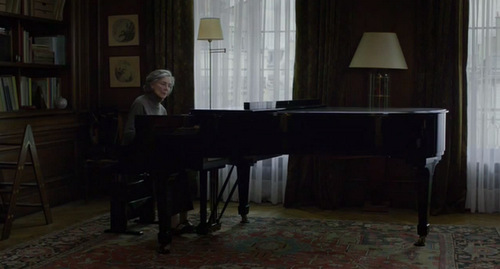
Amour is about a couple, an elderly couple to be exact. Played by Emmanuelle Riva and Jean-Louis Trintignant, they are introduced returning home after attending a classical music concert. In a few deft strokes, Haneke hints at the totality of their shared life: it is mundane, satisfying, sedate, thoroughly interlocked. One morning, he is talking to her in the kitchen, and she suddenly stops. She is awake and stares straight ahead, but she is entirely unresponsive, at least until minutes later when she begins interacting with him as if nothing had happened. They discover this was a stroke, and the deterioration of a human existence begins.
Haneke has noted, somewhat obliquely, that the inspiration for the film comes from a similar situation he experienced in his own family, a loved one laid low by illness, instilling a smothering feeling of helpless in him as he witnessed the suffering progress. According to his cinematic ethos, Haneke relates this scenario with cold, clinical accuracy, and it is acted with heartbreaking rigor by both Riva and Trintignant. There are no reassuring Hollywood tropes here. No nobility to the infirm, no rekindled familial togetherness, no inspiring friendship to be found with a new caretaker. It’s what the audience craves, but it’s not reality, not for most who will experience something like this. Instead, it’s lonely, it’s trying, it’s exhausting, it’s devastating. That’s how Haneke show it to be, though not with pushy emotions or overt manipulations. There is a journalistic detachment that is enhanced by the natural chill of European cinema (Haneke was born in Germany and raised in Austria, and the film is set in France, like his exceptional 2005 effort, Caché). Haneke is a master of the mechanics of filmmaking, especially composing shots, but he doesn’t use his construction skills for exploitative ends in Amour. He is simply taking it all in. If the film is unforgiving, it is only because that’s the proper way to honor the very real dilemmas of aging and the ailments it brings.
Amour is wrenching, but Haneke devoutly avoids calling attention to its sorrows. The vast majority of the film is set in the couple’s apartment, a space that may as well be the entire world once the physical devastation wrought on Riva’s character progresses to the point of incapacitation. It’s obviously everything to her, but it is to Trintignant’s character as well, bound to her as he tends to her ever-growing needs. Again, this comes across as plain fact, not some haunting tragedy. It is a trudge until one finally gives up, out of desperation or mercy. The big monologue about fleeting time on earth, the pageantry and poetry of it all, never arrives. That may be how drama works, with sweeping thematic commentary, but that’s not life, which Haneke is determined to draw accurately. Even when what he’s actually drawing is death.
Discover more from Coffee for Two
Subscribe to get the latest posts sent to your email.
 Coffee for Two