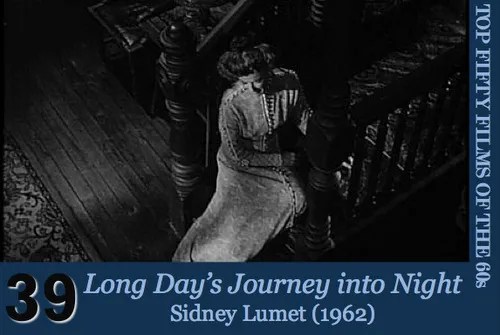
#39 — Long Day’s Journey into Night (Sidney Lumet, 1962)
Much as I admire and even love those films that are told with precise expertise, that lock firmly into place as they deliver their ideas, themes and passions, I maintain an equal affection for those that are messy masterpieces. These are films built upon an unwieldy ambition, exhibiting a probing, questing, even fumbling command of their own material. They often reach operatic heights but also cyclone into troubling incongruities of tone, style or emotional logic. Any sense of artistic balance is sacrificed in the name of live wire creativity that defies any attempt at containment. They can be as thrilling–or even more thrilling–to watch as any carefully calibrated success. It is that sort of teetering wonder that Sidney Lumet made in adapting Long Day’s Journey into Night to the screen.
Written by Eugene O’Neill in the early nineteen-forties, the play wasn’t actually published until after his death, about a decade later. Considered highly autobiographical, the story about a fraught family on the verge of implosions was actually something O’Neill has asked by held for even longer, as much as twenty-five years after he’d made his final exit. Instead, it premiered onstage a little more than two years later, becoming an immediate sensation that snared the Pulitzer Prize. A few years after that, Lumet and his collaborators tried to wrestle it onto film, remaining so faithful to O’Neill’s words that the late author is the only credited screenwriter. A cast was assembled that gave Jason Robards a chance to reprise his lauded stage performance, with Katharine Hepburn, Ralph Richardson and Dean Stockwell brought in to fill key roles. Much of a thrill as it is to see Robards in his virile, slash-grinned glory, interpreting a playwright he was uniquely gifted in interpreting, the true star of the cast is Hepburn. Playing the proud matriarch of the family whose foundational strength has been compromised by a morphine addiction, the performance could be said to be a revelation had she not taken a spin with the florid, fiery words of Tennessee Williams in Suddenly, Last Summer a few years earlier. Her brittle New England certainty, like a sharp rap on the knuckles with a yardstick, creates a fascinating schism with this character circling the abyss, trailing her family with her as she does it.
If Lumet never quite conquers the material, his struggles with it only serve to piercingly illuminate the work’s dark core while also providing a blurry snapshot of the changing state of cinema in the early part of the sixties. There are times when the different performances are seemingly positioned at cross-purposes to one another: Richardson’s boldly intoned classicism, Stockwell’s loopy naturalistic streak and Robards sitting with brilliant unease between the two. This only serves to accentuate the conflicts of the story while also giving the entire film a strange sense that it could spin off in any direction at anytime. Lumet knew the mechanics of narrative as well as any of his peers, but his emotional pitch was solidly with the unfussy rhythms of a busy urban existence. There’s no time for the maudlin or melodramatic, but that’s exactly what O’Neill luxuriates in. The divide between the authors of the images and the words couldn’t be more pronounced, which strangely suits the whole endeavor. There’s warped beauty in the mismatch. Paradoxically, when the strain is most evident is also when the film works the best, when its cascade of misery hits the hardest. The messiness, after all, is an ideal mirror of the Tyrones, watching helplessly as the sanctity of their family falls away like rotting wood.
Discover more from Coffee for Two
Subscribe to get the latest posts sent to your email.
 Coffee for Two