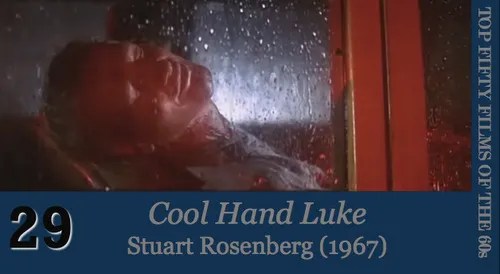
#29 — Cool Hand Luke (Stuart Rosenberg, 1967)
What Cool Hand Luke is going for is made clear as can be right there on the movie poster: “The man…and the motion picture that simply do not conform.” Released at the height of the late-sixties counterculture (just over a week before the film hit theaters there was a war protest in Washington, D.C. that drew tens of thousands and included Abbie Hoffman and Jerry Rubin leading a failed attempt to mentally levitate the Pentagon), Cool Hand Luke embodied the burbling revolt against authority in Lucas Jackson, a man incarcerated for sawing the tops off of parking meters. As played by Paul Newman, Luke is charismatic, devilish and obviously too headstrong for his own good. He’s the quintessential antihero, perpetually committed to miscreant behavior and even caddishness and yet clearly the person who merits attention and affection from the audience. He’s railing against the rules, whether the laws of the land or the firmly established pecking order of the inmate population, because all the rules are rigged against him.
At the time, Stuart Rosenberg was a well-traveled television director whose previous feature, Question 7, managed to snag the National Board of Review Best Film honor for 1961. He brings a surprising lightness and briskness to dark material, never shying away from the brutality of the prison environment, but always structuring the film with a cunning sense of what’s entertaining. Sure, it helps that Luke is played by an actor with genuine movie star presence during the long era when his ability to hold the screen was at its pinnacle, but there’s also a shrewdness to the way Rosenberg builds scenes that establish and then cement Luke’s bravado. Any man who’ll eat fifty eggs because he’s told it can’t be done certainly isn’t going to back down just because a screw in mirrored sunglasses tells him to.
Like a lot of the best films of the nineteen-sixties, Cool Hand Luke practically quivers with the excitement about possibility, reflecting the way American society was being rewritten in the streets. But it’s also about the possibility of narrative filmmaking, the way an entirely familiar cinematic subgenre–in this case, a prison movie–could be turned inside out, taking familiar elements and stretching them to entirely unfamiliar endpoints. That’s in part because the sense of discovery is shadowed by cynicism, a prescient certainty that none of this will actually end well. Possibility naturally entails risk, and there’s always a power structure deeply invested in making certain things don’t change too drastically, at least unless those drastic changes are in their favor. As Luke is celebrated by his peers, he becomes a risk to those charged with keeping all of those peers under control. The prison is a setting. It’s also an enormous metaphor, and Luke’s rebellion within its walls can be extrapolated to make a myriad of things analogous (There’s ample religious imagery within the film, as one example).
The promotional promise was plainly accurate: the film does not conform. If anything, it was one of the major studio efforts that singed a new path, inspiring adherents and kindred artists that so clearly carried its message forward that the original work’s own sense of revolution itself became familiar enough to eventually feel safe. Cool Hand Luke was among the films I remember cropped up on cable superstations when they needed something engaging for a Sunday afternoon. Cool Hand Luke raged against the norm so effectively that it wound up becoming the new norm, not blunted but surely less startling once there was a battalion of echoing followers. That’s simply another risk of nonconformity. Eventually, it can look an awful lot like conformity.
Discover more from Coffee for Two
Subscribe to get the latest posts sent to your email.
 Coffee for Two