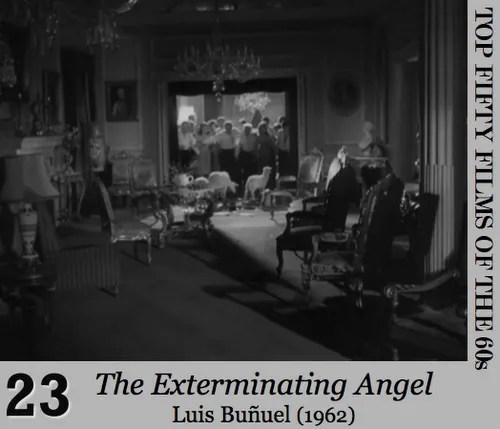
#23 — The Exterminating Angel (Luis Buñuel, 1962)
The guests at a snooty, upper crust dinner party adjourn to the music room, engaging in discussion, whiling away the night. Then the time comes to leave, many of them announcing their imminent departure but none of them seeming to actually exit the room. Initially, they simply get distracted and go back to so idle discussion or activity. It soon becomes clear that something else is going on, something that was partially signaled by various servants rashly leaving their posts earlier in the night. No one will cross the threshold of the room, or perhaps no one actually can. They are trapped in their own tedious privilege, confined by forces unseen and unidentified. The Exterminating Angel finds the ruling class in pathetic stasis, pinned down in the bamboozling yet evocative vision of director Luis Buñuel.
Surely it’s folly to presume to know Buñuel’s intent. The Spanish director had already been creating inscrutable cinema for decades by the point, at least as far back as the point when he and Salvador Dalí decided to test audiences by dragging a straight razor across a delicate eyeball. The Exterminating Angel is a major enough work (it’s even referenced in Woody Allen’s Midnight in Paris, when the time-traveling writer played by Owen Wilson pitches the basic plot to a young Buñuel, who clearly doesn’t get it) that I could probably find a fairly definitive extrapolation of its meaning if I tried, maybe even one backed by the authority of Buñuel’s own testimony. In this instance, though, I prefer the mystery. Buñuel’s work can elicit director’s new clothes sort of reactions, with critics unwilling to expose their own intellectual shortcomings by calling out the impenetrability of the work. While I might occasionally deride that, I fall prey to my own version of it when it’s a film that I connect to, when it’s one that feels right to me. That’s the case with The Exterminating Angel.
Even if I won’t expound on the deeper meaning of The Exterminating Angel with proud certainty, I can still admire its moodiness, its elusive narrative energy, its grim, offhand humor that cuts to the core of the characters’ collective dilemma and the endless capacity they have for class self-aggrandizement, no matter the circumstances. “The disheveled look suits you,” one remarks to another, and it begins to seem that there’s no amount of hardship, existential or otherwise, that they can’t turn into an expression of their own supercilious status. If some of Buñuel’s symbolism seems especially clear–a flock of sheep racing into a church, where they’re evidently greeted by a murderous gunshot–that presumes that clarity is actually a tool at the director’s willing disposal. So much of the film comes across as if it is projected through the lens of his subconscious, so why believe that anything means what it appears to mean, or even what he intends it to mean. Let it be a dark dream, its deeper purpose like sparks in the furthest reaches of the cave. Maybe they’re there. Maybe it’s simply a trick of a hopeful mind.
Discover more from Coffee for Two
Subscribe to get the latest posts sent to your email.
 Coffee for Two