As I consider Pacific Rim, one question nags at me: would I be as charitable towards this film if it were from a director other than Guillermo del Toro? Not that I feel all that charitable towards the film, but as I sat through the procession of overblown digital spectacle populated by thinly conceived characters and driven by a plot holey enough to zing like a Wiffle ball, I had to admit that the damn thing won me over by the end, even as that end indulged in every goofy trope imaginable, including the sort of big, dumb, rousing speech that once transformed the 4th of July into a global holiday. This is, after all, exactly the sort of deliberately empty-headed, big-budget cinematic mayhem that I’ll gladly, vehemently rage against if it issues from the poisonous mind of someone like Michael Bay. Indeed, the towering, lumbering robots employed in the film to fight off equally gargantuan monsters from the ocean deep owe more than a little in their design and CGI realization to Bay’s overly limber Transformers, though del Toro is sure to cite other, cooler antecedents. It’s not as though the screenplay, co-credited to del Toro and Travis Beacham, expands the miserably narrow aspirations of characterization, social insight and wit that typify most modern summer fare. And yet I found myself enjoying it despite the protests of my critical instincts. I’d like to think that it’s attributable to del Toro’s genuine exuberance coming through in the film in the same way that Bay’s disdainful calculation infests his, but what if it’s instead echoes of my appreciation for the director’s prior triumphs muddying up my senses?
For example, I bring more than knowledge of the previous entries on del Toro’s filmography into the viewing. I know about the films he didn’t make, his years toiling away on The Hobbit, a production beset by problems, and his aborted stab at his dream project, an adaptation of H.P. Lovecraft’s novella At the Mountains of Madness. It’s been a full five years since del Toro’s last feature and seven years since his artistic peak of Pan’s Labyrinth, a lifetime in terms of creative momentum. It seemed that del Toro was on the verge of becoming a major director, and his dark, rambunctious imagination is rare and wondrous enough that I was rooting for him to do so, an inclination that I’ll admit probably caused me to slightly overvalue his last film. If the likes of Bay, Gore Verbinski and Zack Snyder get unfettered access to the Hollywood money trough, then I sure as hell want a warped visionary like del Toro to get his spot too.
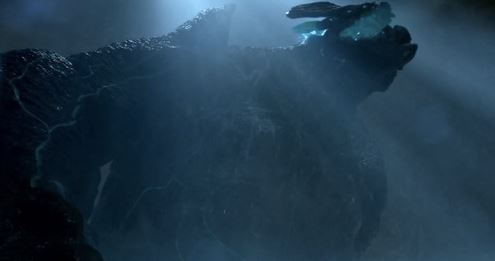
But then there’s a part of me that’s a big disgruntled that Pacific Rim is the sort of thing del Toro unleashed when presented with an open cash register drawer. It could be that he’s overtly trying for a blockbuster after more ambitious projects were dashed, but I’m not sure it’s as simple or as crass as that. For one thing, del Toro has openly professed love for this sort of bounding B movie and has a veritable geek’s museum of old props and masks and other detritus of movieland adventures of the past in his house to prove it. Even if he intriguingly flashes the soul of a morbid poet in films such as The Devil’s Backbone and the previously mentioned Pan’s Labyrinth, there are still strong indications that he’s never happier than when he unleashes big, ugly monsters onscreen to wreak havoc. It’s so clear that a churning giggle of delight can almost be detected, cloaked within the roaring sound effects. If anything, his love of monsters is so formidably present in Pacific Rim that it strains credulity that any effort mounted by humanity, complete with massive robots or not, could ever fell them. The beasts that spring forth from the crack in the ocean floor are lovingly designed to be daunting in the extreme, making them seem completely unbeatable.
Nearly every element I like in Pacific Rim can be traced directly back to del Toro, not because of expert execution on the part of the director, but due to my imagined associations as to how each of those components fits into his creative process. Charlie Day’s jabbering, excitable scientist transcends simple comic relief to become del Toro’s clear stand-in, the only figure in the film whose enthusiasm for the fearsome beasties rivals that of the filmmaker. And the black market dealer specializing in repurposed monster bits could certainly be viewed as hackneyed and overly broad in both conception and performance, but I was endlessly tickled that he’s played by del Toro’s regular collaborator Ron Perlman in a loud suit that I think I’m accurate in describing as Hellboy red, so surely it was selected by directorial dictate rather than on the whim of the costume designer. I could be reading far too much into it all. As it stands, though, I’m not sure it matters. Pacific Rim clearly has no other mandate than to entertain, and it finally achieved that goal for me. Maybe there’s no real reason to agonize about how I got there.
Discover more from Coffee for Two
Subscribe to get the latest posts sent to your email.
 Coffee for Two
One thought on “I hear the human race is fallin’ on its face and hasn’t very far to go”