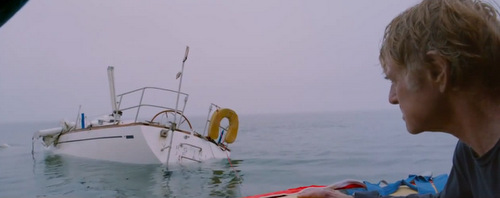
It’s been quite the season for movie stars portraying endurance in the face of overwhelming odds while operating in isolation. While premieres and the resulting opening chatter took place earlier, across successive weekends Sandra Bullock tumbled through space and Tom Hanks faced down pirates on the open sea. Trailing that duo (though it had its festival bow first) is All is Lost, which strands Robert Redford in the middle of the ocean, taking the watery troubles Hanks struggled through and increasing it by a significant degree. Redford’s character is by himself on a sailboat when a collision with a stray shipping container, adrift on the waves, leaves a gaping hole in the side of his vessel and floods it significantly enough to knock out all communication. And this is just the beginning of his woes.
Referencing another Hanks film, All is Lost suggests that writer/director J.C. Chandor watched the 2000 Robert Zemeckis directorial effort Cast Away and found it too talky. Why not eliminate the blood-smeared volleyball providing justification for a bit of dialogue and go from there? Beyond an opening narration and an futile attempt to communicate via the ship’s waterlogged radio, Redford barely utters a word. Indeed, there are precious few noises that escape his throat, Redford stoically trying to fix his wounded transport or deploying yet another piece of impressively designed survival gear. Chandor, Oscar-nominated for typing out an awful lot of words for 2011’s Margin Call, seems to have set himself the challenge of making a movie with a bare minimum amount of dialogue. It’s an impressive chore he’s given himself, admirably achieved, and yet it also holds back the film. All is Lost often comes across as completed exercise rather than compelling artistic vision.
The film is so bereft of the normal trappings of modern narrative films that it winds up feeling fairly empty. Almost no information is provided about Redford’s character. He’s not even granted a name, listed as simply “Our Man” in the credits. That is undoubtedly in keeping with Chandor’s plan, emphasizing the universality of his survival instinct rather than tugging at the audience’s interest with details of a heart-rending history. It makes the film rather hollow, though, leaving the central figure of the film so oblique that he has no definition whatsoever. Redford may as well be playing himself, a Sundance badge dangling from a lanyard around his neck. The sheer mechanics of Chandor’s directing are fairly impressive (at least until a closing sequence that traffics in the exact sort of cheap manipulation and overly beatific imagery others see, mostly inaccurately, in Alfonso Cuarón’s Gravity), but to what end? He may have stood up to his own artistic dare, but the resulting film has no emotion and not much more intellect. It’s not just Redford who’s lost at sea, with little hope of finding solid ground.
Discover more from Coffee for Two
Subscribe to get the latest posts sent to your email.
 Coffee for Two