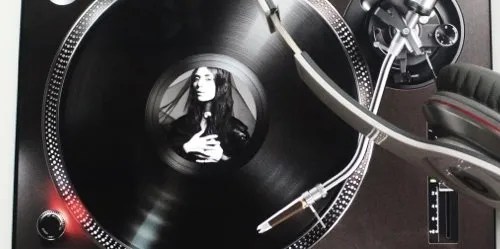
Pop music is always at its truest when it’s speaking about heartbreak. When tougher guitars and a racing, drum-driven backbeat start infringing and the music tips over more clearly into rock ‘n’ roll there are other aspects of the human experience–rebellion, political outrage, basically anything that stirs anger–that are equally suited, but the when the music soften a bit, gets a little swoony, sounds like the soundtrack for a dance floor, especially a lonely dance floor, nothing goes down so sweetly (or bittersweetly, as the case may be) as the harsh agony of thwarted love. The latest proof of this theorem is I Never Learn, the third full-length effort from Swedish performer Lykke Li.
Li has said I Never Learn is the third part of a trilogy that also includes her prior releases, Youth Novels (2008) and Wounded Rhymes (2011). I guess there’s a certain satisfaction in looking at it that way, and I’m sure Li can see the progression of her life in the fairly personal lyrics. Still, it seems like a stretch to me. What’s more, it winds up somewhat diminishing the new album to consider it that. It’s less of a culmination than a progression, or even a hard-earned reinvention, albeit not a radical one. While Li is a singer-songwriter at heart, her previous albums were dense with dynamics, as if she were drawing on her homeland’s longstanding reputation for bizarrely brilliant, stealthily intricate pop wonders and then coating the most modern version off it over emotional songs like an irresistible candy shell. That approach is scaled back on I Never Learn to deliver something leaner and arguably more pure. It’s not quite akin to Beck abandoning his loopy, electro-funk soundscapes to create the stark, sorrowful beauty of Sea Change, but it’s in the same amphitheater. Plainly put, I Never Learn is a break-up album. With song titles like “Love Me Like I’m Not Made of Stone,” “Never Gonna Love Again,” and “Sleeping Along,” how could it be anything but?
The album gets underway with the title cut. Atop a sweet, tender, lush acoustic guitar line that could have been lifted from an old album by the Church, Li sings, “I’m right here, I’m your star-crossed lover/ I lie here like a starless lover/ I’ll die here as your phantom lover.” The repetitive language seems very deliberate: this is Li being painfully direct, expressing herself in the clearest manner possible. There is poetry to be found, but speaking straight from the heart–especially a damaged heart–often makes more intricate language elusive, or maybe just not worth the effort. Li sounds just this side of exhausted on much of the album, as if the process of crossing through from the smashed glass of a ended relationship to the artistic expression of what she’s gone through has left her on the brink of collapse. On a song like “Just Like a Dream,” it sometimes sounds like she might not make it all the way to the end. This isn’t a problem. If anything, it gives an added purpose–an anguished need–to the music.
The lean, confessional nature of the album is satisfying, but the withdrawing tide of Li’s more complex sonic exploring has some challenges, too. “Never Gonna Love Again,” with its lyrics of “Every time the rain falls/ Think of me,” comes across as drippy as something on later album by the Bangles. Now that’s not necessarily a bad thing. Forlorn pop holds up pretty well to high-gloss simplicity. “Never Gonna Love Again” could wear thin after a while, but it’s just as likely to feel like a welcome anthem for all those in need or those who’ve ever been in need. And that’s just about everyone, right? That’s what songs like these are there for.
Discover more from Coffee for Two
Subscribe to get the latest posts sent to your email.
 Coffee for Two