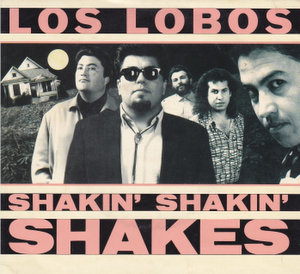
184. Los Lobos, “Shakin’, Shakin’, Shakes”
“Shakin’, Shakin’, Shakes” was the first single Los Lobos released in the calendar year 1987. Then it was totally eclipsed by a very different song they issued a few months later. By most accounts, the recording of their sophomore major label effort, By the Light of the Moon, was an arduous process. There was undoubtedly some pressure to deliver a strong follow-up to How Will the Wolf Survive?, the band’s 1984 album, which enjoyed only modest success but firmly established Los Lobos as a critical favorite. Just as importantly, some of that adulation stemmed from the pointed, heartfelt political commentary found on the earlier album, which made the band especially stand out in a pop culture increasingly defined by the inescapable superficiality of MTV. Notably different impulses were at play with the chief creative personnel of the Los Lobos: David Hidalgo was writing songs that continued that trajectory of sharp commentary, and Cesar Rosas was tending towards simpler romps that showcased the crack musicianship of the band, versatilely drawing on a multitude of styles to arrive at something that felt distinctly true to their own voice. At least for the first single, Rosas’s instincts won out, and the relatively straightforward song he wrote with producer T-Bone Burnett was chosen to represent the album. Arguably compounding the minor identity crisis, in the midst of recording By the Light of the Moon, the band was visited in the studio by filmmakers Taylor Hackford and Luis Valdez, who were producing and directing, respectively, a biopic about legendary rock ‘n’ roll star Ritchie Valens. They wanted to recruit Los Lobos to record several of Valens’s songs for the soundtrack, including the track that would effectively be the film’s title cut, “La Bamba.” When the band’s cover version of the departed singer’s signature song was released, it dominated radio all summer long, eventually spending three weeks on the top of the Billboard chart. No matter how much toil and effort Los Lobos had put into the material on By the Light of the Moon, including “Shakin’, Shakin’, Shake,” it was their effort as caretaker of someone else’s song that delivered them the biggest hit, by far, of their collective career.

183. Soul Asylum, “Sometime to Return”
When Soul Asylum released their major label debut, Hang Time, in 1988, there was no way they could avoid comparisons to the other major college rock bands operating in their hometown. They were already used to having the name Hüsker Dü flung at them with regularity. It was unavoidable, really. Soul Asylum opened for Hüsker Dü on the band’s tour to support the album Flip Your Wig, and Bob Mould took a break from bashing out his own music to produce Soul Asylum’s sophomore album, Made to Be Broken. Some invocations of the Replacements started to come up with the arrival of Hang Time, thanks in part to the polish brought to Soul Asylum’s music by producers Lenny Kaye and Ed Stasium. As with Pleased to Meet Me, the Replacements album released about a year earlier, there was a sense that scruffy hooligans from the Twin Cities were trying to clean up their act to appeal to a broader audience. That may very well have been the case, but that didn’t necessarily prevent Soul Asylum from delivering terrific songs. It was thumping rock ‘n’ roll with a punk spine. The lead single, “Sometime to Return,” stands as a prime example, maybe the best track the band ever banged out, even if other later songs turned into improbably big hits. It perfectly captures a certain set of twentysomething confusions, doing so with such conviction that even nonsensical lyrics like “Throw away you calendar/ And saddle up your salamander” start to sound like profound expressions of aching youth. As the lead singer and chief songwriter Dave Pirner acknowledged at around the time, that accuracy in the song’s outlook was because they put every bit of themselves into the music. He said, “If our message was something we could separate from the music, something we could sum up, we wouldn’t need to make records.”
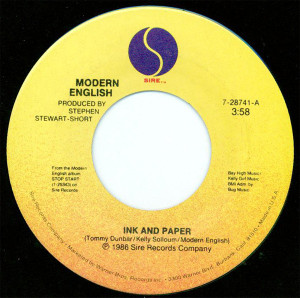
182. Modern English, “Ink and Paper”
Though there was nary a trace of the song making even the dinkiest dent of the commercial charts upon its release, “Ink and Paper” is retroactively considered one Modern English’s bigger hits. Even so, many members of the band have practically no affection for it, because of a simple and fairly understandable reason: it’s barely one of their songs. For Stop Start, the band’s fourth album, Modern English left 4AD to throw in entirely with Sire Records, their label in United States. The decision led to unhappy results. Lead singer Robbie Grey later conceded that the band got trapped in trying to shift their music to suit the United States audience, saying, “The albums on 4AD, which was English-based, were much more of our sound. We kind of tried to put on Stetson hats and boots and tried Americana, but we weren’t very good at it.” For the first single, Sire chose “Ink and Paper,” which is the only track on the album on which the band shared songwriting credits, with Kelly Solloum and former Rubinoos guitarist Tommy Dunbar. Modern English guitarist Mick Conroy explained, “Kelly and Tommy were friends of our manager in New York. Tommy spent some time with us in the States. We all threw ideas at each other. He then put bits and pieces together and then we recorded it but with more of an upbeat feel, plus a mad sax solo. With the older stuff, we credited the whole band as songwriters, whether or not we had all actually been part of the songwriting, as we had done from the start.” By the band’s estimation, Sire provided inadequate promotion of the album, in part because they were putting a lot of energy towards a different artist on their roster in 1986. After “Ink and Paper” stalled out on all but the college charts, Sire never bothered with a follow-up single. Spurred in part by the clear disinterest from their own label, Modern English disbanded shortly thereafter, though their absence was short-lived. By 1990, they were again releasing music under the Modern English name.
As we go along, I’ll build a YouTube playlist of all the songs in the countdown. The hyperlinks associated with each numeric entry lead directly to the individual song on the playlist. All images nicked from Discogs.
Discover more from Coffee for Two
Subscribe to get the latest posts sent to your email.
 Coffee for Two