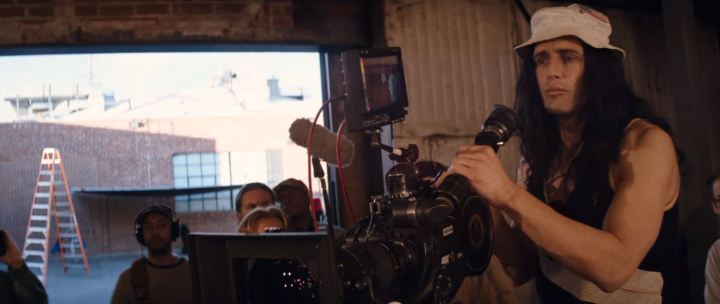
The Disaster Artist would have been easy to structure as a prolonged dumb joke. It would have been simpler to structure it as a mean joke, delivering judgmental comic blows against the misguided dreamers that move through it’s lifted-from-real-life plot. In bringing a memoir about the making of The Room, a low-budget, independent feature that has taken of the title of Worst Movie of All Time, director James Franco wisely opts for a different approach. Even as it gently mocks the gang of misfits who throw in their lot with filmmaker Tommy Wiseau (played by Franco), The Disaster Artist is ultimately sympathetic, as Tim Burton’s Ed Wood was a generation ago.
In playing Wiseau, Franco delivers an uncommonly committed performance. He has Tommy’s strange accent and equally offbeat speech patterns to hide behind, but the willfully eclipsing of his own genial stoner persona is more complete. There’s no winking at the camera to signal personal superiority to the fledgling director he plays. Franco shows every sign of believing in Tommy as thoroughly as the man himself does, lending the performance a level of dignity that honors the more off-putting complications. There are plenty of laughs to be had from Tommy’s garbled syntax, confused impulsiveness, and misguided intensity — and the screenplay, credited to Scott Neustadter and Michael H. Weber, exploits those opportunities well — but Franco knows there’s genuine pathos there, too. Addressing it empathetically gives the movie weight.
Perhaps the most surprising aspect of Franco’s directing is his skillful hand with actors. Long an aspiring artistic polymath with a relentless disinclination to refuse opportunities, Franco has built a formidable contact list. He uses it judiciously, somehow never letting the string of name performers in small roles become an indulgent distraction. Instead, he gives the actors the room to develop and inhabit fully-realized characters in the space of a few moments. In the early going, Melanie Griffith, Megan Mullally, and Sharon Stone arrive in relatively quick success, each given little more than a cameo in a single scene. And each is great, better than they’ve been in years. (Griffith shows more immediate authenticity playing an acting teacher than I’ve ever seen from her before.) That generosity transformed into great thespian merit extended across the cast, with Seth Rogen, Ari Graynor, Paul Scheer, and especially Dave Franco turning in quite marvelous work.
Befitting its subject, The Disaster Artist isn’t without its own significant wobbles. There’s an annoyingly superfluous introduction featuring various actors proclaiming their love of The Room, and a closing nod to the original production that places Franco’s recreations side-by-side with Wiseau’s footage goes on at least twice as long as it should. Those are minor, though. There are more problematic elements in the script, notably when it strains to shovel extra drama into the proceedings and then concocts an entirely implausible premiere audience reaction in an apparent attempt to dramatize The Room‘s journey from baffling drama to cult classic comedy, and its creator’s opportunistic embrace of that unintended result.
It’s the single-screening evolution of The Room from bust to boom that rankles most, largely because it runs counter to lessons that Franco has brought into the act of filmmaking. It’s not enough to want art to happen. Patience, care, and dedication are required, along with a little luck. The Disaster Artist evidences that knowledge in most of its craft. It would be more a more complete and satisfying work if the same knowledge were as assuredly present in its plotting.
Discover more from Coffee for Two
Subscribe to get the latest posts sent to your email.
 Coffee for Two