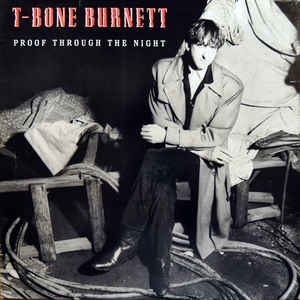
992. T Bone Burnett, Proof Through the Night (1983)
In the early nineteen-eighties, T Bone Burnett was a musician of high regard who hadn’t yet broken through. A few years earlier, Burnett earned his keep as a guitar-slinger on Bob Dylan’s much-loved Rolling Thunder Revue. That helped him get enough industry buzz to record and release a couple of solo records, neither of which fully clicked commercially. For many in his sphere, there was an inkling that Proof Through the Night was going to be different.
Taking a distinctly literary approach to his lyrics, Burnett crafted a batch of sober, gently moralizing songs. They yearn to have a stripped down, similar to Bruce Springsteen’s Nebraska, released one year earlier. That’s not really how it worked for an unproven artist at the dawn of the MTV era, though. To Burnett’s dismay, the songs were glossed up by producer Jeff Eyrich, whose sole behind the boards credit to that point was the single “A Million Miles Away,” a minor hit for the Plimsouls. All across Proof Through the Night, it’s very evident there’s a misguided attempt to fluff Burnett’s stark transplanted fictions into something more slickly radio-friendly.
For enough listeners (including Rolling Stone critics, who awarded Burnett Best Songwriter honors in their year-end poll), Burnett’s voice comes through. “When the Night Falls,” written with Roy Orbison in mind, is fairly indicative, coupling evocative lyrics to a melody and song structure that betray a deep appreciation for classic rock ‘n’ roll styles. “Pressure” is a fine honky tonk stomper, and “After All These Years” has a touch of Burnett’s old tour bus compatriot Dylan in its wistful, romantic remembrance.
Elsewhere, the skinned knuckle short story approach of Burnett’s songwriting is a little more troublesome. “Fatally Beautiful” delivers its lyrics about a female who stirred amorous attention her whole life, receiving predatory attention in the process (“She was born in the back of ’34 Ford/ Raised in a foster home/ Her guardian made sexual connection with her/ Before she was even grown”) with an unsettling jauntiness. There’s also the odd spoken word song “Hefner and Disney,” in which Burnett takes particular pleasure is making the latter into a figure of lurid tastes.
Burnett was disappointed enough with the finished product that it took years — decades, really — for Proof Through the Night to make its way onto CD. In the more immediate aftermath, he committed to the idea that, when it came to producing, he knew better. The first Burnett solo records had been self-produced, but now he was ready to serve in that capacity for other artists, signing his name to albums from Leo Kottke and Los Lobos before the year was out.
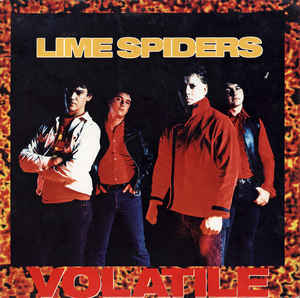
991. Lime Spiders, Volatile (1988)
“Volatile,” the opening track and title cut on the Lime Spiders’ 1988 album, opens with a bellow straight out of the Arthur Brown playbook. To those with a working familiarity with the half-crazed output of the English singer, there could be few better signals as to the blazing, boisterous music to come across two vinyl sides. “I’m out to lunch/ And you know I got a real short fuse,” Mick Blood sings, and it is both warning and conspiratorial celebration.
The Lime Spiders were an Australian band that looped a barbed wire lasso around garage punk and dragged it ruthlessly through the blood-dappled mosh pit of punk rock. The band had already gone through a whole batch of iterations — complete with messy breakups and perilous rejuvenations — by the time they released their debut full-length, The Cave Comes Alive!, in 1987. Less than a year later, Volatile hit record racks.
Given that so much of Volatile is angry rock ‘n’ roll that roars along like a turbo-charged bulldozer, it’s downright jarring — in the best sense of the word — when the music tilts ever so slightly toward a gentler vibe, as on the “The Odyssey,” which is what the Monkees would have dished out had they been a smudged carbon copy of the Who instead of the Beatles. And it’s no surprise that “The Other Side of You” was a single complete with a polished music video. It has the melodic jangle so common in the era, when labels were convinced the easiest way to get their products onto college radio was to make certain the songs could segue comfortable into or out of a chiming R.E.M. jam.
The barroom brawl quality of their music was undeniable, but Lime Spiders also demonstrated a strong command of general tunefulness. “My Main Attraction” is reminiscent of the great pop songs nested in heavy buzz that were Hüsker Dü’s bread and jam, and even the swampy grind of “Test Pattern” slyly shows off a lot of craft.
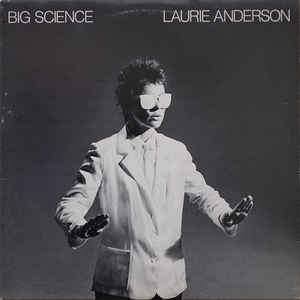
990. Laurie Anderson, Big Science (1982)
There are many roads an artist can travel to a comfy major label contract. Befitting the resolutely avant-garde music she created, Laurie Anderson surely had one of the oddest routes to become a member of the Warner Bros. galaxy of stars.
Primarily a performance artist through the nineteen-seventies, Anderson routinely had music as a central component of her pieces, such as Duets on Ice, which found her playing her modified, electrified violin while wearing skates embedded in two blocks of ice. She even released a few singles with tiny press runs. One of those offerings was inspired by a performance of “O Souverain,” from the 1885 opera El Cid. With a chipper cheekiness that would become a trademark, Anderson created “O Superman,” an abstract rumination on American military force set to a pulsing sample of her own voice. She used a small grant — a mere five hundred dollars — from the National Endowment of the Arts to release it as a single. To surprise of the few people who were paying attention, “O Superman” became a hit, especially in the U.K. where it made it all the way to the runner-up position on the singles chart.
Amazingly, the strange sensation Anderson generated was enough for Warner Bros., which gave her a multi-album deal. Anderson took the money and plunged it into her art, developing the material that would comprise Big Science, her debut album.
Even decades later, Big Science is spectacularly bizarre. Album opener “From the Air” repeats the technique of building Anderson’s vocal samples into a unnervingly unshakable rhythm track. And then she adds swerving horns, as if Anderson found a classic New Orleans brass band on a night of high revelry and corralled them into the studio, keeping them unbalanced with strobe lights as they played. And all that’s before Anderson comes in playing a airline pilot, using blandly lackadaisical tones to instruct the passengers to prepare for a crash landing: “This is your captain, and we are going down/ We are all going down, together/ And I said: ‘Uh oh, this is gonna be some day.”
Understandably, the album lives in a space somewhere between challenging art piece and fun record to play on a Saturday night. No matter where it sits on that continuum, it boasts tracks of grand pop invention (including, of course, “O Superman”). “Born, Never Asked” generates poignant delicacy out of Anderson’s sparking violin, and “Example #22” is spectacular cartoon theme reeling from a gulp of questionable acid.
It remains unclear to me whether or not Warner Bros. knew what they were getting into by bringing Anderson under their banner. There’s got to be some pride, though. There can’t be too many other releases in label history afforded a honored place in the Museum of Modern Art.
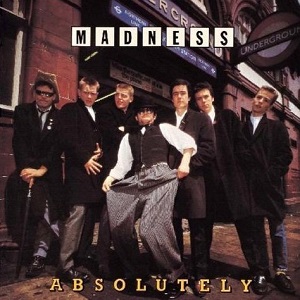
989. Madness, Absolutely (1980).
Although their day would come on the U.S. pop charts, the English ska band Madness was met with a strong dose of resistance on this side of the Atlantic as they dished out their early albums. Around the time of the group’s sophomore album, Absolutely, the churlish tastemakers at Rolling Stone mustered up the most scathing insult they could, deeming Madness “the Blues Brothers with English accents.”
Without leveling a judgment on the quality of Absolutely, it’s easy to hear why the songs would hit American ears with a clang. There’s something deeply English about the songs, mostly in the way they seem firmly grounded in the life of row houses and Teddy Boys. Often, the allusions are right there in the lyrics (as with the jittery pop reminiscences of “Baggy Trousers” or the loping “On the Beat Pete,” about a constable with size ten feet). Even when the references aren’t so overt, there’s a prevailing sense that it belongs to a very specific culture, albeit one that blithely appropriated the sound from elsewhere.
Taken on its own terms, there’s dandy material across Absolutely. “Close Escape” boasts an opening so bouncy it should be sung from a careening pogo stick, and the rockabilly pastiche “Solid Gone” taps into London’s retro scene as effectively as other more celebrated artists did. The loose swing of “Not Home Today” could be an outtake from The Clash’s Sandinista!, which I consider a nosebleed-high compliment. “Shadow of Fear” is arguably the cheeriest song about ghoulish happenings ever recorded, and “You Said” is a splendid shrug of a breakup song (“You said you’re leaving, well that’s okay/ You said you’ve had enough, what can I say?”).
Aside from college radio, none of these songs registered on U.S radio at all. At home in the U.K., Madness racked up a bunch of Top 10 singles. To the blokes in Madness, it probably didn’t matter all that much that the U.S. music writers were slow to find the joy and invention in Absolutely.
To learn more about this gigantic endeavor, head over to the introduction. Other entries can be found at the CMJ Top 1000 tag. Most of the images in these posts come straight from the invaluable Discogs.
Discover more from Coffee for Two
Subscribe to get the latest posts sent to your email.
 Coffee for Two