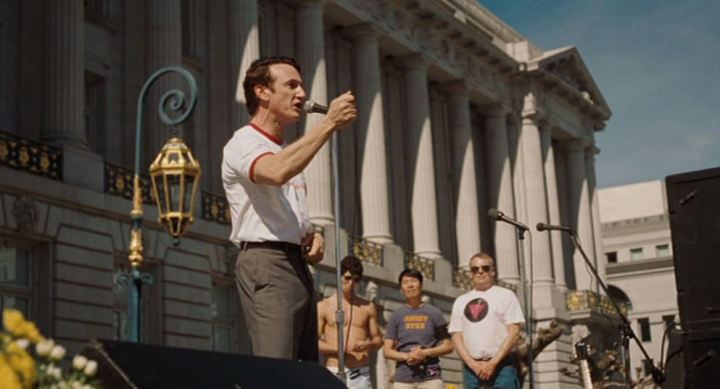
Don’t forget to leave Milk and cookies out for Santa, because after a long night of delivering presents, he could surely use both a snack and an Oscar-winning biopic of a pioneering politician. I wrote this review upon the release of Gus Van Sant’s film, in the afterglow of the 2008 election. Ten years later — and now forty years since Mile was shot and killed — the continuation of hateful assaults on progress are deeply dismaying. In the face of this, persistence is vital. The life and legacy of Harvey Milk stand as a reminder of this. I opened with a silly joke, but there’s a serious lesson to be drawn from Milk. So, sure, make Santa watch it again. Make everyone watch it again.
Gus Van Sant’s new film, Milk, arrives a very particular point in time, a time that informs, shadows, enhances and, sadly, refutes it. While I contend that the best films have a timeless quality to them — and Milk generally meets that criteria — there’s something to be said for a movie that feels of the moment. Whether it is intended or not, a film can feel like a direct response to the year, month, week, even minute that it was released. That sensation was heavy on me while Milk unspooled, so why ignore it. Instead, let’s take it head on.
On Election Day of this year, the American public made a historic choice for the highest office in the land that stood in direct opposition to a tarnished national legacy of institutionalized prejudice. Suddenly, finally, there was fresh, uplifting evidence that the promise of equality scratched across treatises of freedom at the dawning of the nation held some validity. They weren’t cynical words, after all; not just the posturing of the rebellious wealthy in the face of an empire. The words could be true, and the speculative hopes put forth by a wise preacher decades and decades earlier, hopes about content of character having more value than color of skin, had some small but significant fulfillment checked and punched and tapped on the ballots of an electorate collectively putting aside fear and hatred.
And yet. Yet.
On that same day, many Americans did cast ballots marked by intolerance and hostility. In Florida, in Arizona, and, most famously and infamously, in California, voters backed measures that effectively told a group of people that they deserved fewer rights than their fellow citizens. We could congratulate ourselves, even if only in some small measure, but there remains the fact that, nationally, we’ve transferred that vicious judgment to be leveled against people on the basis of who they love. No matter who will stand in Washington, D.C. next month to swear an oath of office for the Presidency of the United States, we still maintain a social tyranny.
Milk does not take place in this time. It takes place thirty years earlier, when a man named Harvey Milk moved to San Francisco and developed the revolutionary notion that being a gay man didn’t automatically disassociate him from the political process. He could, he believed, be openly gay and be elected to public office. He ran and ran and ran again, finally winning a spot on the city’s board of supervisors. With the post, he gained respect, popularity, and influence. He worked to effect positive change for his constituents and discovered firsthand that those who challenge the system, even through working by its rules, can meet tragically untimely ends.
Van Sant’s film tells this story with respect and aplomb. The screenplay by Big Love writer and co-producer Dustin Lance Black focuses on Milk’s ascendancy in the world of politics, not just his runs for office but as a community activist, using the fiscal influence of the burgeoning gay community in San Francisco’s Castro district to change local attitudes and policies. That focus is sometimes too intense, perhaps. Harvey Milk’s personal relationships are notably less well drawn and, therefore, less interesting the further away they are from the center of his political life. That’s arguably appropriate given that the film argues that Milk’s unrelenting drive alienated those who grew weary of the gamesmanship inherent to politics, but it also blunts the impact of many of the heavier emotional scenes.
What does work in those scenes, just as it works throughout, is the astonishing acting alchemy of Sean Penn’s performance in the title role. I never expected Penn to equal his riveting work in 1995’s Dead Man Walking and here he’s bettered it. Penn, usually a tightly-wound actor, is the loosest he’s been onscreen since he debated the merits of punctuality with Mr. Hand. More than Milk’s shrewdness, more than his ambition or ingenuity, Penn taps into the man’s joy and hopefulness and uses that to shape the performance. When an unexpected victory occurs late in the film, one that is something of a photo-negative of more recent outcomes, the emotions that wash over his face lift the film from the familiar terrain of biographical filmmaking, with its predictable course of setbacks and achievements. For a moment, a heart-rending moment, it is beautifully real. The impact of a mass of people stating through their ballot box action that all people matter, all people deserve consideration, becomes more than a movie movement. It becomes a statement of vivid purpose and honorable belief, driven home by the explosive relief and touching rush of validation expressed by Penn.
Van Sant is largely in the mode of seasoned professional here, which suits the material (indeed, his few flourishes are distracting). If the film is staid, it is also sturdy. The filmmakers make a reasonable choice to let Milk carry the film, both the man and the man who depicts him. That yields a finely passionate work and, unarguably, a story worth telling. Especially now.
Discover more from Coffee for Two
Subscribe to get the latest posts sent to your email.
 Coffee for Two