These posts celebrate the movie trailers, movie posters, commercials, print ads, and other promotional material that stand as their own works of art.
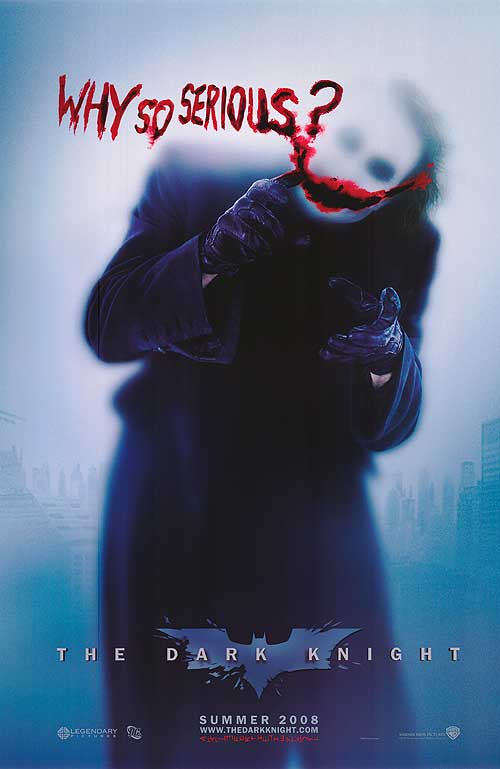
What a strange, innocent time it was, when movie theater operators first unrolled the teaser posters for the 2008 release The Dark Knight returns and affixed them to their walls. Like the second installment of director Christopher Nolan’s trilogy of Batman films, Iron Man, the opening salvo from upstart Marvel Studios, was a coming attraction, its post-credits bending of all the rules entirely unknown to the general populace. Although superhero films had achieved significant box office success, status as the dominant commercial cinematic genre of the day was still a few page turns away.
And the arch enemy of the caped crusader, a grinning villain called the Joker, had only the barest hint of true danger about him. He was skewing darker in the comic books, to be sure, the natural evolution from the transformative portraits introduced separately by writers Frank Miller and Alan Moore two decades earlier. But in countenance and carriage, he was still deeply connected to his legacy as the clown prince of crime. On the big screen, he had been portrayed by Cesar Romero and Jack Nicholson, with roughly comparable commitments to instilling gravity into their portrayals. For most audiences, there was only the faintest notion of the Joker as anything other than a campy conniver.
The teaser poster for Nolan’s The Dark Knight which featured a full-length introductory image of Heath Ledger’s turn as the Joker, obscured yet unmistakable, was wholesale change delivered via one-sheet. It haunted everything that followed and totally defined the character moving forward. More than that, the complexities of Nolan’s film and Ledger’s acting were ultimately less impactful for filmmakers who followed in making most DC comics film adaptations than the starkly gruesome image of dark, thick blood smeared into a smile. When Jared Leto was foolhardy enough to try and follow in Ledger’s shuffling footsteps, he essentially played the poster.
Like Watchmen, the comic book series, The Dark Knight had a seismic effect on DC superhero storytelling that followed, and the symmetry extends to an astonishing inability of succeeding creators to discern what made the inspiring work so effective. It was only the most superficial elements that were graspable, evidently. The impact was detrimental, but the original still holds power. Few posters from recent years are locked into my memory like that one.
Other entries in this series can be found by clicking on the “Art of the Sell” tag.
Discover more from Coffee for Two
Subscribe to get the latest posts sent to your email.
 Coffee for Two