Since great television comedy always begins with the script, this series of posts considers the individual episodes that have claimed the Primetime Emmy Award for Outstanding Writing for a Comedy Series over the years.
The members of the Television Academy of Arts and Sciences who voted in the category that recognized comedy writing through the late nineteen-seventies and early nineteen-eighties clearly admired Taxi. In its five seasons on the air, the sitcom about the employees of the Sunshine Cab Company received at least one writing nomination every year. M*A*S*H was its only consistent competitor in that span. In its third season, Taxi claimed three of the five nominations in the category and took home its first win.
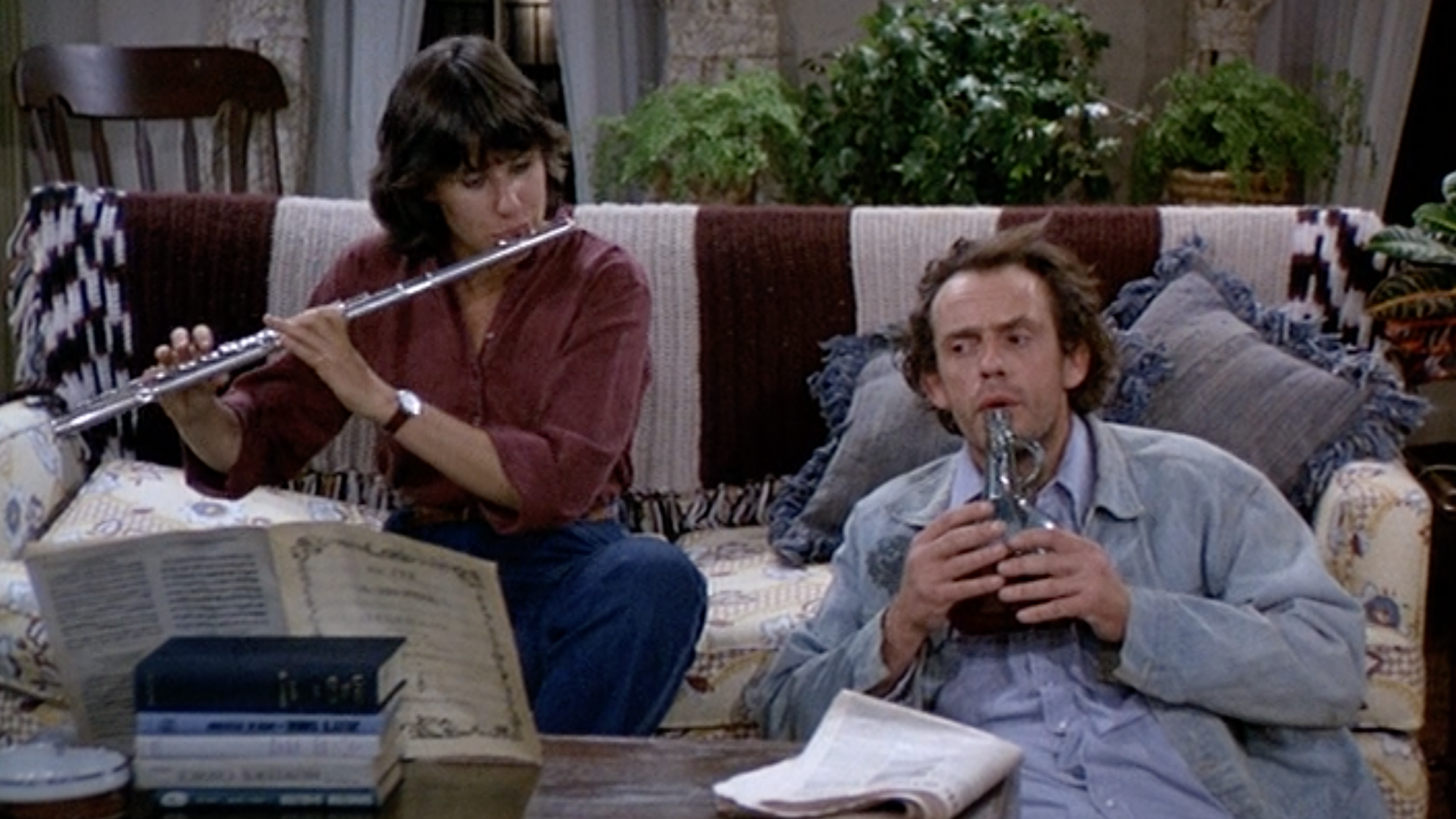
“Tony’s Sister and Jim” introduces the character of Monica Banta (Julie Kavner), the newly divorced sister of palooka cabbie Tony Banta (Tony Danza). She moves back to New York City to get a fresh start, and Tony is determined to set her up with his good guy coworker Alex (Judd Hirsch). Instead, Monica becomes smitten with Jim Ignatowski (Christopher Lloyd), the denim-clad burnout who also made his living behind the wheel of the bulky yellow vehicles dispatched from the garage. In a predictable narrative arc, Tony is originally riled to overprotective behavior but eventually relents and lets Monica make her own choices.
Like the Taxi episode that nabbed a writing Emmy the following year, “Tony’s Sister and Jim” is largely successful because it properly exploits the astounding comic performance of Lloyd. Writer Michael Leeson undoubtedly comes up with good lines for the character, but its the inspired backspin Lloyd puts on the line readings that elevates the humor. Although Lloyd would go on to win a pair of trophies for his work on Taxi, he wasn’t even nominated for this third season, his first full year as a series regular. In the category for supporting actors in a comedy, Danny DeVito took the trophy for his turn as the villainous Louie De Palma on the show.
Leeson was credited on two other taxi episodes and went on to write on a whole slew of other television and film projects. In writing for the big screen, Leeson’s most impressive credit was on the 1989 black comedy The War of the Roses. The director of that film was, of course, DeVito.
Other posts in this series can be found at the “Golden Words” tag.
Discover more from Coffee for Two
Subscribe to get the latest posts sent to your email.
 Coffee for Two