Since great television comedy always begins with the script, this series of posts considers the individual episodes that have claimed the Primetime Emmy Award for Outstanding Writing for a Comedy Series over the years.
The wise wagerer would have bet against Frasier when the spinoff series was announced in the spring of 1993. NBC batted around different ideas for continuing select characters from the longtime Thursday night sitcom anchor Cheers when the show’s creators officially decided that the end of the eleventh season would be closing time. There was a pitch for just about every character who spent time in the below-ground tavern, and the network was reportedly most bullish on a buddy comedy built around beloved barflies Norm and Cliff (George Wendt and John Ratzenberger, respectively). They settled instead on following the post-Cheers trajectory of the role played by Kelsey Grammer, stuffy psychiatrist Dr. Frasier Crane, mostly because they already had a deal in place with Grammer and producers David Angell, Peter Casey, and David Lee. After a concept that would have cast Grammer as a reclusive, wheelchair-bound publisher was rejected by Paramount, the studio producing the show, Angell, Casey, and Lee switched to what they knew everyone wanted: a Cheers star continuing to hit the exact same comic beats.
If the notion of proceeding with a spinoff centered on a character chosen more by default than any indication of who audiences were clamoring to see more of made the prospect of success suspect, precedent wasn’t particular in Frasier‘s favor either. The series would debut remarkable close to the ten-year anniversary of the premiere episode of AfterMASH, the notorious flop that spun off of M*A*S*H and a haunting showbiz cautionary tale about following up a consensus classic. And the previous attempt at a Cheers spinoff, The Tortellis, was a confused failure. Skepticism about Frasier was high enough that it needed a perfect pilot episode to overcome it. Luckily, a perfect pilot episode is exactly what it had.
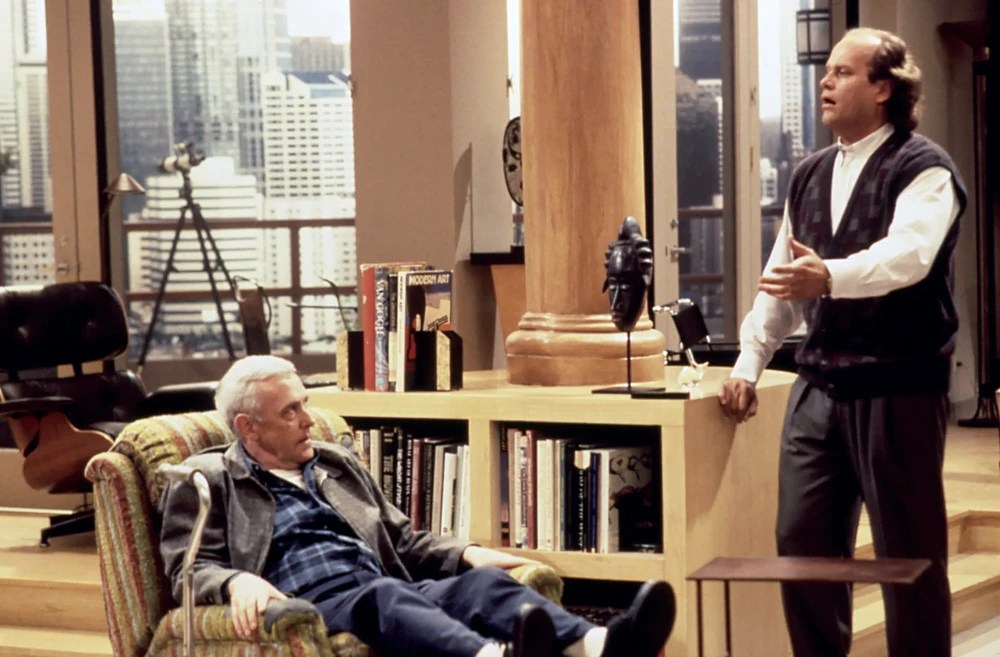
Everyone involved with Frasier were firmly insistent that they were making a whole new sitcom that just so happened to include the character of Frasier Crane. In the pilot episode, titled “The Good Son” and cowritten by the producing trio, they lay out the particulars of the show’s storyline so meticulously that each element could be neatly introduced with the scene-setting title cards that surely became a conceit they regretted in the years to come. “The Job” shows Frasier at his new job as a Seattle radio host and introduces his producer, Roz (Peri Gilpin). “The Brother” introduces Frasier’s previously unmentioned younger sibling, Niles (David Hyde Pierce), and economically establishes him as more persnickety and pompous (the guiding principle that Niles is who Frasier would have been if he hadn’t loosened up at Cheers is blazingly clear from that first scene). “The Father” brings in Frasier’s gruff, earthy father, Martin (John Mahoney, immediately invaluable), “Eddie” adds Martin’s overly attentive pooch, and “The Home Care Specialist” completes the primary cast with Daphne (Jane Leeves), a live-in nurse hired to help with Martin, who recently moved in with his eldest son due to his struggles rehabilitating from an on-the-job injury that hastened the end of his career as a police officer. Along the way, each of the main settings — the broadcast studio where Frasier works, the coffee shop where he hangs out, and his apartment — is laid out so clearly that they are immediately familiar.
The clarity and distinction of “The Good Son” wouldn’t really matter if the jokes weren’t funny. They are. Frasier quickly asserts itself as a worthy successor to Cheers, which had already cemented its place in the canon of the greatest U.S. sitcoms of all time. Frasier had the benefit of starting with Grammer’s expert ability to play both arrogant, gruffly intolerant erudition and vulnerable acceptance of his own need to grow, somehow making the disparate traits believably housed in the same person. Against that, the writers set ideal foils, whether Martin’s everyman simplicity or Daphne’s cheerful kookiness. It easy to see how the comedic dynamics can be rejuvenated from episode to episode.
That theoretically bet against Frasier would have been a bust. The show was a hit, finishing in the Nielsen Top 10 for the year (behind Coach and ahead of Monday Night Football), and it scooped up a bunch of Emmys for its first year, including trophies for Grammer and the writing and directing of the pilot episode. It also won in the award for Outstanding Comedy Series, a feat Cheers also managed in its first year. Frasier bested its predecessor when it came to sustained dominance in its category, triumphing for each of its first five seasons. That winning streak had never been accomplished by any series before, comedy or drama. Frasier went on to run for eleven seasons, just like Cheers.
Other posts in this series can be found at the “Golden Words” tag.
Discover more from Coffee for Two
Subscribe to get the latest posts sent to your email.
 Coffee for Two