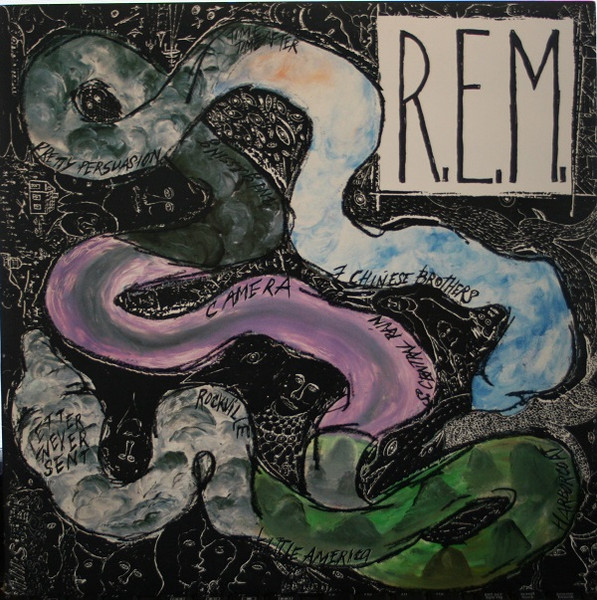
10. R.E.M., Reckoning (1984)
R.E.M. got off to an impressive start with their debut LP, Murmur. The quartet from Athens, Georgia made the record with only modest expectations and a keen awareness that their spare, cerebral music wasn’t exactly aligned with the brand of pop music that roared up to the top of the charts at the time. The critics, though, absolutely adored the album. It drew raves from every pocket of music journalism. When Rolling Stone was still the primary driver for setting the canon of rock ‘n’ roll, their critics collectively declared Murmur the best album of the year it was released, elevating it past heavy duty contenders in Michael Jackson’s Thriller and U2’s War. Although radio play for the band was still negligible, Murmur managed a very respectable peak position of #36 on the Billboard album chart. The effusive plaudits were undoubtedly key to driving sales of the record.
“It’s nice, it’s flattering, and it helps,” Bill Berry, drummer of R.E.M., noted of the championing of the band by the music press at around that time. “Traditionally the track record of the past has shown us that critics’ choice bands don’t make it big commercially, but that’s fine with us anyway. We’d rather be a critics’ choice than a sell-out, commercial, Top 10 group.”
Even if achieving flashy commercial breakthrough wasn’t a primary concern for R.E.M. (to the occasional irritation of I.R.S. Records, their label for the first few albums), the bandmates — Berry, guitarist Peter Buck, bassist Mike Mills, and lead vocalist Michael Stipe — knew that expectations had been raised for the follow-up to Murmur. They had plenty of songs more or less ready to go for the new album, some that were already established parts of the band’s live repertoire that didn’t quite fit for their debut and several more from prolific writing binges that occurred in the wake of that debut.
R.E.M. initially shopped around for a new studio collaborator, laying down more than twenty demo tracks with Elliot Mazer, Neil Young’s regular producer. The situation didn’t feel right, though, and R.E.M. quickly decided to embrace the familiar. For their second album, Reckoning, the group circled back. Like Murmur, the album was produced by Don Dixon and Mitch Easter and recorded at Reflection Sound, in Charlotte, North Carolina. The comfort the band felt inspired them to race through the recording sessions with a minimum of fuss, hoping they would capture some of the ragged spontaneity of their live shows in the process.
“That was just an exercise in velocity,” Stipe said many years later, reflecting on the making of Reckoning. “I think I was trying to somehow zoom through any sophomore jinx. ‘Cause the record before had gotten so much attention, we were like, ‘We’re punk rock, we’re DIY, we’re gonna fuckin’ put this thing down in ten days.’ And it was a bold move. We did it in twelve days or whatever.”
At other times, Buck claimed the album was recorded in ten days or less and that they spent no more than two days mixing it. There might have been a little myth-making going on with those estimates. Easter agreed the making of Reckoning was atypically quick, but he regularly insisted it took twice as long as the timeframes offered in the band members’ boasts. What is clear is that there was a different energy at play, and it comes through on the album with a driving urgency.
Reckoning opens with “Harborcoat,” which has just enough of a clattery quiver to signal that the ethereal style of Murmur is getting a shake-up. Stipe’s vocals are more prominent, but the jaggedly cryptic lyrics keep a simple understanding of the song’s meaning out of reach: “They crowded up to Lenin with their noses worn off/ A handshake is worthy if it’s all that you’ve got/ Metal shivs on wood push through our back/ There’s a splinter in your eye and it reads, ‘React.'” Although the words are more open and inviting at other points on the album, R.E.M. makes an immediate statement that they’re not going to pander to the audience, no matter how much moaning there was in certain quarters about the obliqueness of the songs.
“We try to create four minutes of feeling,” Mills explained at the time. “That feeling or meaning does not have to be the same for each person. Everyone experiences a song by their own experiences and therefore draws their own conclusions. Music is intensely personal; we’re not trying to make political statements or direct people’s lives, only create moods. Listeners can fill in their own details.”
In some ways, Reckoning is distinctly less distant than its predecessor. Next to the album’s title on the spine is the phrase “File Under Water.” What seems like an cheeky instruction is instead an alternate title for Reckoning. Indeed, Stipe maintains that File Under Water is the real name of the album. That conviction is backed up by the plentiful water metaphors that flow through the album, including on the yearning “So. Central Rain (I’m Sorry)” (“Did you never call? I waited for your call/ These rivers of suggestion are driving me away/ The ocean sang, the conversation’s dimmed/ Go build yourself another dream, this choice isn’t mine”) and the jangly, stately ballad “Time After Time (Annelise)” (“Ask the girl of the hour/ By the water tower’s watch/ We can fight if you want/ But who will turn out the lights?”). Jabbing, deliberate “7 Chinese Brothers” is built around Stipe moaning the chorus “7 Chinese brothers swallowing the ocean/ Seven thousand years to sleep away the pain.” The recurring motifs give Reckoning a feel of an album that is offering points of connection.
Yet other songs are even more direct. “(Don’t Go Back to) Rockville” is a catchy, country-tinged plea to a loved one to to stick around, even with the concession that doing so might not be for the best (“It’s not as though I really need you/ If you were here I’d only bleed you/ But everybody else in town only wants to bring you down/ And that’s not how it ought to be”), and “Letter Never Sent” uses a graspable central metaphor to clarify more abstract expressions of lonely sorrow (“The thought of the catacombs/ Left my soul at home/ This letter never sent/ And it’s so far, it’s so dark, I’m so lost”). Maybe the listeners don’t have to fill in quite as many details as before.
“They were semi-highfalutin, but they were highfalutin in a correct way,” Easter said of R.E.M. many years later. “They had some standards, but they weren’t weird purists. They weren’t unrealistic. If they got on the radio, that was okay with them, but I don’t think they catered to it. They were very easy for me to relate to because I had the same aesthetics. I don’t hate commercial music at all. They wanted to check out the universe of playing in a band and doing all the stuff you can do.”
That sense of exuberant possibility prevails on the album. R.E.M. doesn’t pursue wild reinvention on Reckoning, but they noticeably flex their creative muscles to see how different poses feel. “Pretty Persuasion” has an anxious spirit (“He’s got a pretty persuasion/ She’s got pretty persuasion/ God damn, pure confusion”), and “Camera” is as languid as chilled mercury. “Little America” fairly bristles as it gallops along, and “Second Guessing” has a sinewy, punk-steeped snarl (“Oh, why are you trying to second guess me/ I am tired of second guessing/ Who will be your look this season/ Who will be your book this season”) that essentially forecasts what Hüsker Dü would sound like when they gave in to their poppier sensibilities on later albums.
Whatever pressure R.E.M. felt from their music biz overlords, they remained very true to themselves on Reckoning. As a result, they fortified their fan base more than they expanded on it. In the commercial marketplace, Reckoning performed only marginally better than Murmur, peaking a few places higher on the chart. That strategy was absolutely perfect to lock in the devotion of college radio. The distaste for chasing the fleeting pop zeitgeist came across as R.E.M. gratefully accepting their place as titans of the left end of the dial. They found and formed their community.
“With Murmur, we were between being unknown and a little bit known,” Buck observed as the band toured in support of Reckoning. “Now, the difference is between being kind of successful and really successful. Murmur came out unheralded, but we knew this album would get a lot of attention. Now, what we do kind of matters to people. We know there’s a market out there; we’re not creating in a vacuum anymore. Knowing that, you can’t help but worry a little bit about how things will be received, but we weren’t too worried about Reckoning. We were happy with it.”
To learn more about this gigantic endeavor, head over to the introduction. Other entries can be found at the CMJ Top 1000 tag. Most of the images in these posts come straight from the invaluable Discogs.
Discover more from Coffee for Two
Subscribe to get the latest posts sent to your email.
 Coffee for Two