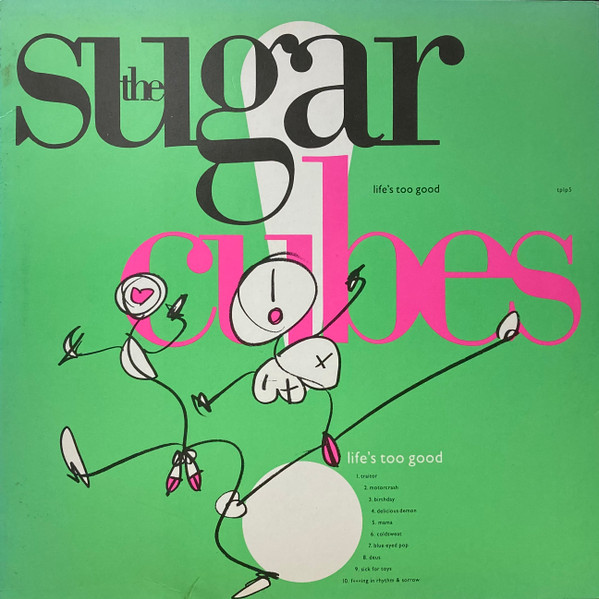
9. The Sugarcubes, Life’s Too Good (1988)
Everyone in the band Kukl knew that knew that they’d reached the end. The group formed in Reykjavík, Iceland, in the summer of 1983. Initially meant as an one-off for the final episode of Áfangar, a radio show that featured underground rock, Kukl spent a few years dispensing jarring music on stage and on record, embracing a raggedy, DIY ethic all the while. The various members had already started drifting off to other endeavors when Kukl was booked to play a thirty-minute set on Icelandic television. The on-air appearance raised a fair amount of consternation, as viewers complained about the disarmingly odd music and the sight of the lead singer, a young woman named Björk Guðmundsdóttir, wailing out vocals with her very pregnant belly exposed. Supposedly, one elderly woman was so dismayed by what was coming through her television set that she was struck down by a heart attack. Officially, Kukl never played together again.
As Kukl was ending, many of its participants were already playing a different type of music in a loosely assembled group that was more or less the house band for a newly formed art collective and record label called Smekkleysa, inspired by the Pablo Picasso quote “Good taste and frugality are the enemies of creativity” (Smekkleysa translates to “Bad Taste” in English). The new band took a far less abrasive tack, crafting pop songs that might have been complex and challenging but were also approachable. Demonstrating her flair for impish showmanship that would later earn her renown and occasional ridicule, Björk claimed the band that followed Kukl officially came into being on the same day that he son was born: June 8, 1986. The son was named Sindri Eldon. The band was called the Sugarcubes.
Initially, the Sugarcubes took their time creating new material. There were plenty of diversions for the various band members, including an acting job for Björk in a film called The Juniper Tree. The often worked through song ideas when rehearsing, employing the communal spirit of most Smekkleysa endeavors. The result was songs that were dynamic, layered, and decidedly unpredictable.
“It’s a very cacophonic thing,” Sigtryggur Baldursson, the Sugarcubes’ drummer, said of the band’s process. “I see it as you throw in all kinds of ingredients into a pot, cook it up, stir it, and out comes this. And it’s different every time. We’ve always liked to do whatever we feel is fun each time. We don’t have this strong sense of ‘No, this doesn’t sound like us.'”
Using a bounty of funds raised from commemorative postcards issued by Bad Taste for the meeting between Ronald Reagan and Mikhail Gorbachev that took place in Reykjavik, the Sugarcubes recorded and released the single “Birthday.” Hypnotic and forceful, the track showcases vocals by Björk that are unlike practically anything that had been pressed into record before. Her voice soars and growls, sometimes in the same breath, and she regularly warps words with inventive phrasing. The journey takes through the lyrics “Today is her birthday/ They’re smoking cigars/ He’s got a chain of flowers/ And sews a bird in her knickers” alone rivals a David Lynch cinematic opus in its enveloping delirium.
Influential British DJ John Peel got ahold of “Birthday” and championed it on his radio show. The British music press followed with similar plaudits, and soon the Sugarcubes were besieged by offers from big and small record labels. Savvy from their time as partners in Bad Taste, the Sugarcubes rejected overtures from conglomerates that were sure to lean on them for hits and instead signed with dinky U.K. label One Little Indian, which had been formed just a couple years earlier by a bunch of anarcho-punk musicians who wanted more control of how their music was delivered to the marketplace. Based on favorable interactions with an Elektra Records A&R rep, the Sugarcubes opted for that much larger label for their U.S. releases. Derek Birkett, the former bassist of Flux of Pink Indians, was running One Little Indian, and he brought in Ray Shulman, of Gentle Giant fame, to help the Sugarcubes take the songs they’d already started recording in Iceland and get them into their finished state.
“The way I got into production was — and, in fact, throughout the early 80s, I actually got into TV adverts, that was my main kind of living — I was working in the studio with a guy there called Derek Birkett,” Shulman recollected many years later. “He had his own label and he found this band from Iceland called the Sugarcubes and said, ‘What can you do? Can you record them?’ And I said, ‘Yeah, I’ll record them.’ So basically, with a few sessions here and a few sessions there, we put together that album.”
That album is Life’s Too Good, and it is a powerhouse. In addition to serving as the LP home for “Birthday,” the album holds a treasure trove of appealingly eccentric pop songs. Björk wasn’t exactly a secret weapon by this point, but the album still slow plays the introduction of the stunning fury of her voice. Opener “Traitor” is jagged art rock with Björk’s vocals echoing distantly in a way that only begins to hint at their otherworldly power, and even the next track, the pulsating “Motorcrash,” holds back for a bit, finally unleashing her fully on the lyrics “Then we disguised ourselves/ Took a taxi to her home/ When her husband answered the door/ She introduced herself, he said/ ‘Where have you been all this time?'” Line by line, it seems like she can knock down walls with the sheer force of her singing. She gives steely strength to lyrics that are often abstract, though Björk insisted at the time that every last line was grounded in the simplest aspects of human existence.
“I think ours is one of the most real musics going on these days,” Björk said. “It’s just about normal people doing normal things. They’re sitting in chairs, eating food, they’re happy, and they’re sad.”
Understandably, the attention directed at the band quickly centered on Björk. That had some ill effects on band harmony. Although Björk was the predominant author the words she sang, the band was foundational an egalitarian outfit. And she wasn’t the only lead vocalist. She was simply most magnetic band member filling that role. Einar Örn Benediktsson also handled, typically in a braying speak-sing that was certainly distinctive but also mainly effective because of the way it contrasted with Björk’s performance at the microphone. “Sick for Toys” is emblematic, sounding like a luxuriant Sinéad O’Connor ballad that’s been harshly ambushed by the Fall’s Mark E. Smith slinging his spiky verbal confrontations. “Delicious Demon” has similar friction; it feels like the Sugarcubes’ version of a party anthem, as if they’re a version of the B-52s beamed in from a dimension on the other side of funhouse mirror.
There were suggestions from some on the Sugarcubes roster that they saw their efforts as a lark that tickles at parody. There are certainly hints of that mischievous outlook on that record: “Blue Eyed Pop” takes a guitar riff that wouldn’t sound out of place on an INXS strutter and strafes it with odd elements, and “Fucking in Rhythm & Sorrow” suggests Bow Wow Wow leveraging their rhythmic energy to dominate at a hoedown. If Life’s Too Good is partially a jibe at standard pop trappings, it’s also an album of thrilling wonders that masters the form its obliquely criticizing, whether in the swirling intensity of “Mama,” the thunderous “Coldsweat,” or the blobby amble “Deus” (“Deus does not exist/ But if he does, he lives up on me/ In the fattest largest cloud up there/ He’s whiter than white and cleaner then clean”).
The Sugarcubes started to crumble almost as soon as their first album hit shops. The music press’s focus on Björk wore her out and roused resentment in other band members, particularly Einar Örn. The band’s broadly collaborative ethos proved unsustainable the further they got from the humble confines of their scrappy Icelandic arts community. There were differing opinions about the musical direction they should take the band, and subsequent albums, though speckled with highlights, were chaotic and dulled by compromise. The Sugarcubes announced their dissolution in late 1992, less than five years after their seismic debut album.
“Don’t expect anything from the Sugarcubes,” Einar Örn told Spin not long after the release of Life’s Too Good. “We will let you down in the end.”
To learn more about this gigantic endeavor, head over to the introduction. Other entries can be found at the CMJ Top 1000 tag. Most of the images in these posts come straight from the invaluable Discogs.
Discover more from Coffee for Two
Subscribe to get the latest posts sent to your email.
 Coffee for Two