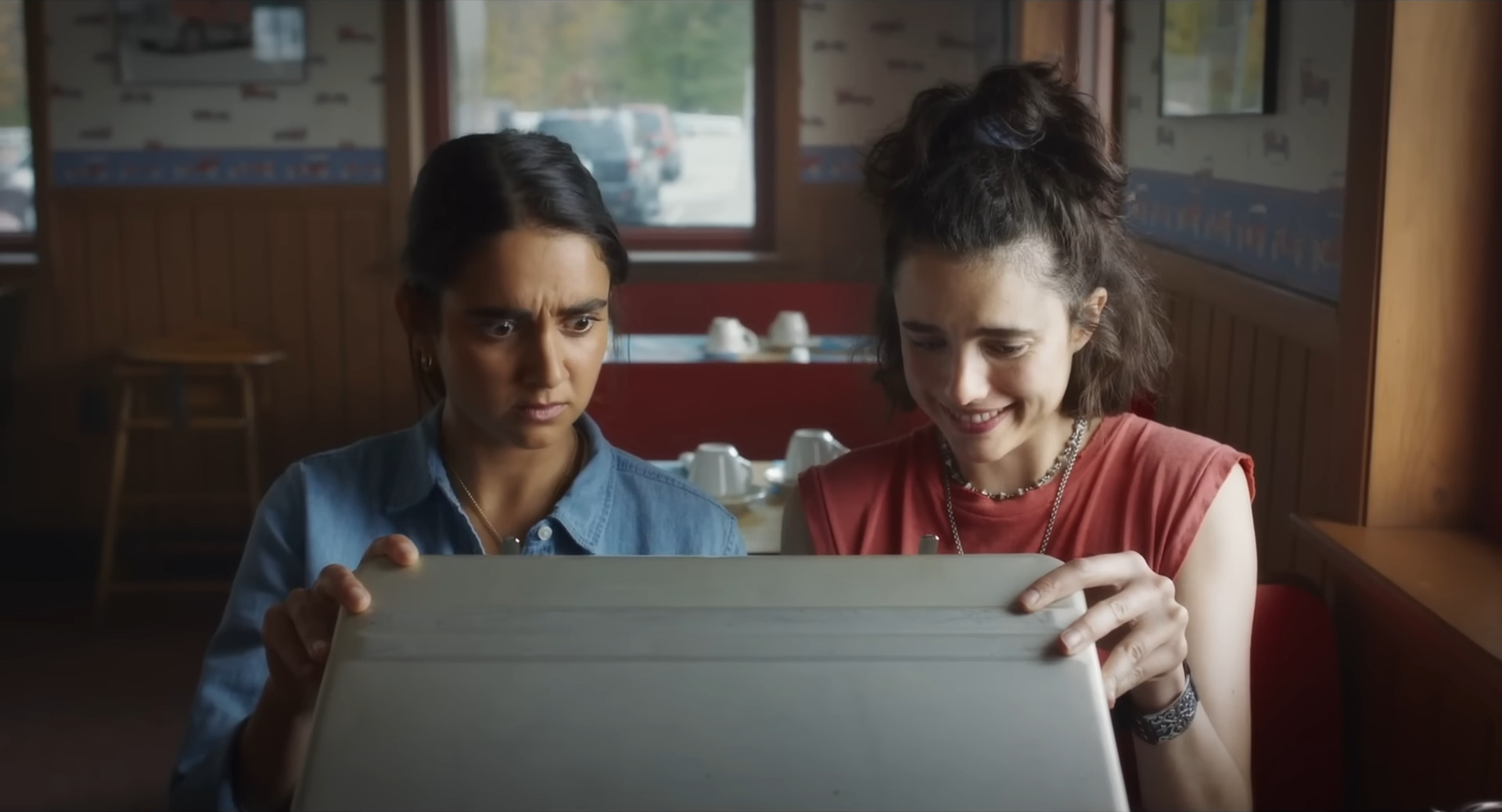
Now that both Coen brothers have put narrative features into the cinematic universe following their first divergence from working in tandem after thirty-plus years, it’s fascinating to compare and contrast what they created without a sibling to answer to. With The Tragedy of Macbeth, released about two years ago, Joel Coen adapted Shakespeare with striking, expressionistic visuals and a grim, determined countenance. It’s a work unlike anything else in the Coens’ joint filmography. Now, Ethan Coen follows with Drive-Away Dolls, a yammering crime caper that feels, well, an awful lot like a Coen brothers movie.
Like several predecessors that Ethan Coen signed his name to, Drive-Away Dolls features cheerful misfits who get mixed up in malfeasance, running afoul of brutish crooks, some who operated with godlike self-assurance and many who are a few stamps short of proper postage. In this case, the innocents who blunder into trouble are Jamie (Margaret Qualley) and Marian (Geraldine Viswanathan), lesbian pals who distract themselves from their respective woes by taking a road trip to Tallahassee. In an attempt to save money, they secure a vehicle from a driveaway service. Some other party needs to have a car transported to Florida, so Jamie and Marian do the driving. The problem is that the automobile in question has some illicit materials, and they weren’t the ones who were supposed to be behind the wheel, leading a crew of nasty fellows to become very invested in tracking them down.
Ethan Coen co-wrote Drive-Away Dolls with his spouse, Tricia Cooke (who also edited and produced the film), and it seems she’s more accommodating of cartoonish business than her brother-in-law. The film is littered with obnoxiously kinetic scene transitions and juvenile humor (I feel confident this will be the only film released by an Oscar-winning director this year that is dedicated to Cynthia Plaster Caster). Much as the proud brashness of the saucy lesbian adventuring comes across as admirably revolutionary, the storytelling lacks a snap. It’s like Coen is mushing together leftover ideas, vainly hoping that a compelling plot emerges simply because the previous dishes were winners. The comedy has as many misses as hits, and, in the end, the hubbub doesn’t add up to anything.
A few of the performers do manage to elevate the material. Beanie Feldstein is often very funny as Jamie’s angry ex, and Bill Camp is a deadpan scene stealer as the proprietor of the driveaway service. Qualley and Viswanathan are an appealing team, building in just enough warmth to make the friendship understandable up against the context of their characters’ mismatched temperaments. Qualley is particularly strong in a few scenes where she’s tasked with delivering dense dialogue jammed with charmingly ornate language, a Coen brothers trademark. The unavoidable conclusion is that she deserves to graduate to a proper feature shaped and helmed by both Joel and Ethan working at or close to peak of their collaborative powers, which only underscores how much Drive-Away Dolls stays stuck at the level of a tryout league.
Discover more from Coffee for Two
Subscribe to get the latest posts sent to your email.
 Coffee for Two