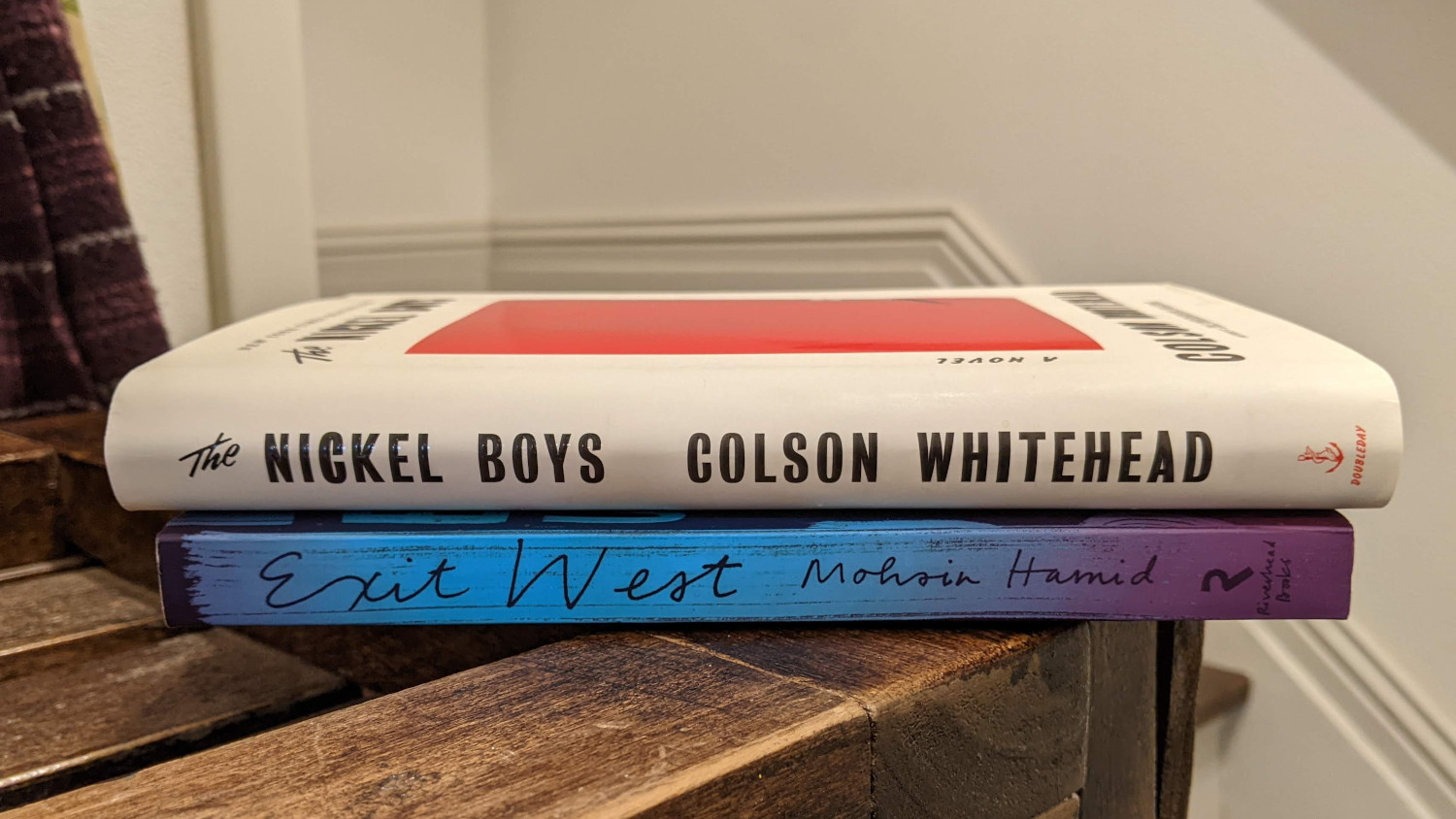
The Nickel Boys by Colson Whitehead
Fiction, 2019
There were three of them. The biggest one he’d seen last night, the boy who looked too old to attend Nickel. The giant was named Griff; in addition to his mature appearance, he was broad-chested and hunched like a brown bear. Griff’s daddy, it was said, was on a chain gang in Alabama for murdering his mother, making his meanness a handed-down thing. Griff’s two pals were Elwood’s size, lean on the bone but wild and cruel in the eyes. Lonnie’s wild bulldog face tapered into a bullet at his shaved scalp. He’d scrounged up a patchy mustache and had a habit of smoothing it with his thumb and index finger when he calculated brutality. The last member of the trio was called Black Mike. He was a wiry youth from Opelousas who was in constant battle with restless blood; this morning he wobbled in his seat and sat on his hands to keep them from flying off. The three of them owned the other end of the table—the seats between were empty because everyone else knew better.
When Colson Whitehead claimed the Pulitzer Prize for The Nickel Boys, he became one of only four writers (following Booth Tarkington, William Faulkner, and John Updike) to win the award for fiction twice. More remarkably, Whitehead is the only person to achieve the feat with consecutive novels, which suggests that The Nickel Boys must be a staggering work to prompt to Pulitzer folks to set such a precedent. Friends, it is.
The story is mostly set in the nineteen-sixties and follows a Black high school student who is railroaded into a stay at a brutally cruel reform school in Florida. The persecution built into the school’s system is more pronounced for the Black residents, and Whitehead illuminates that grotesque manifestation of prejudice with piercing clarity. Whitehead doesn’t flinch, burrowing into the interiority of the characters to make their misery almost palpable to the reader. And yet the book never feels exploitative. The storytelling is so fine and true that it almost comes across as narrative nonfiction (the Nickel Academy is partially based on the Dozier School for Boys, a real Florida reform school that saw its crimes against children exposed in the last couple decades). Rough as the journey can get, Whitehead is the steadiest of guides.
Exit West by Mohsin Hamid
Fiction, 2017
War in Saeed and Nadia’s city revealed itself to be an intimate experience, combatants pressed close together, front lines defined at the level of the street one took to work, the school one’s sister attended, the house of one’s aunt’s best friend, the shop where one bought cigarettes. Saeed’s mother thought she saw a former student of hers firing with much determination and focus a machine gun mounted on the back of a pickup truck. She looked at him and he looked at her and he did not turn and shoot her, so she suspected it was him, although Saeed’s father said it meant nothing more than that she had seen a man who wished to fire in another direction. She remembered the boy as shy, with a stutter and a quick mind for mathematics, a good boy, but she could not remember his name. She wondered if it had really been him, and whether she should feel alarmed or relieved if it had. If the militants won, she supposed, it might not be entirely bad to know people on their side.
In Exit West, Nadia and Saeed are two young people in a city under siege. Though unidentified, the place is reminiscent of some Middle East regions that are beset by violent conflicts between fervent factions. As the danger rises, Nadia and Saeed move into a romantic relationship and plot their escape.
Mohsin Hamid’s novel freely and unassumingly incorporates magical realism to make its points about the travails faced by refugees. No matter how determined they are to put down roots in the places they flee to, the couple are in a near-constant state of displacement. They endure exploitation from people who recognize their desperation and encounter dispiriting factionalism among their cohort of fellow refugees. At times, the escape can feel just as treacherous as the trap they left. Hamid writes their tale with a burning empathy. He doesn’t lionize the characters; they are markedly human in their faults and foibles, which Hamid underscores with occasional vignettes about individuals around the world going their own very different challenges and triumphs. What Hamid does provide for the characters is a level of dignity that their circumstances often strips away.
Discover more from Coffee for Two
Subscribe to get the latest posts sent to your email.
 Coffee for Two