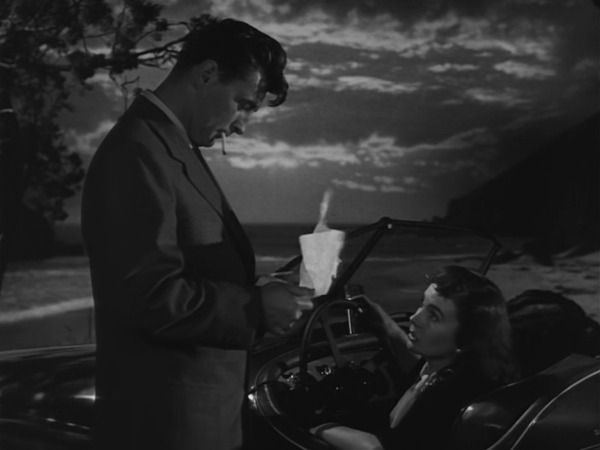
Angel Face (Otto Preminger, 1952). Frank Jessup (Robert Mitchum) works as an ambulance driver as he scrimps together savings to fulfill his dream of opening up a hot rod repair shop. An emergency call at a mansion causes him to cross paths with Diane Tremayne (Jean Simmons), the household’s sullen but alluring daughter. Frank bumbles into a romance with Diane and becomes employed as the family’s chauffeur as he clings to his new paramour’s promise that she’ll orchestrate an investment in his planned business. In the classic film noir structure of Angel Face, Diane is the femme fatale and Frank is the patsy. The plot proceeds accordingly. Director Otto Preminger opts for a fine slow burn that becomes simply slow in the third act. Mitchum played this sort of role repeatedly, and he seems a little bored in this one. By contrast, Simmons is fantastic. She plays her character’s scheming shrewdness with an exploratory energy before pivoting effectively to later scenes where she’s a person numbed by guilt over all those devious doings.
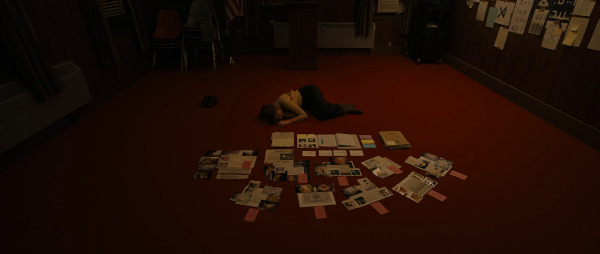
Longlegs (Osgood Perkins, 2024). Written and directed by Osgood Perkins, the horror film Longlegs is hyper-stylized in a way that papers over the plot problems for a surprisingly long time. The story locks in with Lee Harker (Maika Monroe), a fresh-faced FBI agent in nineteen-nineties Oregon whose sleuthing is aided by vague psychic abilities. She is brought onto a disturbing case involving murder-suicides that are attributed to the mysterious influence of a serial killer known as Longlegs (Nicolas Cage). As Lee grows obsessed with the case, her own unsettling past comes slinking to the forefront. Perkins directs the film like it’s Seven in a heavy depressant haze or a David Lynch outing with more commercial underpinnings. The story doesn’t really make sense, but Perkins’ approach implicit argues that it doesn’t really have to if the film’s tipsy moodiness is effective enough. Unless realizes by a real cinematic master, that daring and laudable notion can only last for so many reels. When the third act comes along, Perkins so thoroughly gives in to his most bonkers instincts without and counterbalancing insight or depth that the film collapses under its own gloopy unreality.
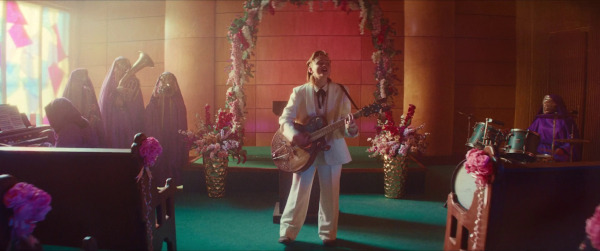
O’Dessa (Geremy Jasper, 2025). Ambitiously, proudly oddball, Geremy Jasper’s science fiction musical has a fable-like quality and also plays footsie with satire. It comes across as a very nineteen-eighties vision of a dystopian future, a little Streets of Fire, a little Escape from New York, a little The Running Man. That’s a lot of stylization for one film to contain, and Jasper can’t quite wrestle it into a consistent, coherent form. In a dystopian future, O’Dessa Galloway (Sadie Sink) is a young woman who leaves her rural home and heads to the big city with her later father’s gleaming guitar in hand. She’s determined the meet the destiny for greatness she’s sure if waiting for her despite whatever opposition she might face, including that of Plutonovich (Murray Bartlett), the showboating media manipulator who rules over the land. There’s a love story, of course, and all manner of twisty side adventures as O’Dessa periodically breaks into song. None of the tunes is particularly memorable, and the storytelling is so eager and headlong that it sometimes feels improvisatory in a way that makes the whole film feel more confused than determined. Most of the performances stick at a surface level, though it’s strangely entertaining to watch Regina Hall romp through her villain role like she’s Whoopi Goldberg doing a Grace Jones impression to play Aunty Entity.
Discover more from Coffee for Two
Subscribe to get the latest posts sent to your email.
 Coffee for Two