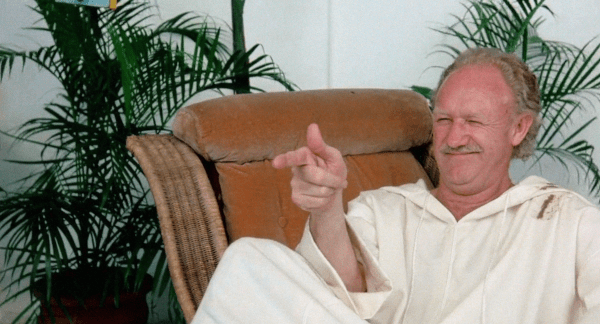
Eureka (Nicolas Roeg, 1983). As is probably expected of a film directed by Nicolas Roeg as he pushed into the latter half of his career, Eureka is just completely bonkers stuff. The movie packs all this in: Rutger Hauer walking around as a semi-stunned patsy Lothario, Joe Pesci as a Jewish business thug, Mickey Rourke at peak levels of slithery suaveness, and Theresa Russell oscillating between cuddly coolness and go-for-broke fury. That list doesn’t even include star Gene Hackman, who clearly decided early in the project that loosely calibrated yelling was acting enough to snag the paycheck. The film is drawn from the true-life tale of a murdered industrialist in the nineteen-forties, but verisimilitude isn’t an cinematic quality Roeg has the slightest interest in. He wants florid mania and sweaty sexuality, and he absolutely gets it. The filmmaker includes a narratively dubious voodoo orgy right in the middle of the film, because of course he does. Tempting as it is to declare this sort of unhinged storytelling defies binary assessments of good and bad, Eureka has a slapdash feel that totally sinks it.

Sly Lives! (aka the Burden of Black Genius) (Ahmir “Questlove” Thompson, 2025). The new music documentary from Ahmir “Questlove” Thompson is a bit of a comedown from the delirious highs of Summer of Soul, but what wouldn’t be? It’s still incredibly engaging to watch the director bring his unerring sense of rhythm to the construction of a documentary. With an artful mix of archival footage and contemporary interviews, Thompson traces the history of Sly Stone, from early incursions to the music industry to full-blown rock stardom to hermetic withdrawal. The film doesn’t elide more problematic turns in Stone’s live, but it doesn’t luridly dwell on them either. Thompson is primarily interested in the creative life of his subject, and he makes a compelling case that Stone could contend for the title of musical genius during his peak. He knew how to channel the formidable talent around him to realize songs of towering impact. Among the interview subjects, Jimmy Jam is the MVP, expertly and enthusiastically conveying why Sly Stone’s music is revolutionary.

You’re a Big Boy Now (Francis Ford Coppola, 1966). With his second feature, Francis Ford Coppola strides forward as a director of grand inventiveness. Scenes are infused with energy and there’s a welcome prickliness to the sexual politics. Adapted from a 1963 novel by David Benedictus, You’re a Big Boy Now follows Bernard Chanticleer (Peter Kastner), a naive nineteen-year-old who moves to the big city. He deals with his domineering parents (Geraldine Page and Rip Torn, matching forces of nature) and is romantically entangled with both a pretty actress (Elizabeth Hartman) and a childhood friend (Karen Black). This is all presented with the countercultural sensibility of the boomer generation starting to feel their burgeoning social authority. If some of the satire falls flat, Coppola still does better with it than many of his contemporaries operating in the same warped comic mode. The location shooting is consistently impressive, making New York City in one of its more downtrodden eras feel intensely alive. The Lovin’ Spoonful contribute a batch of songs, and the band’s music works great up against Coppola’s rambunctious visuals and sharp edits.
Discover more from Coffee for Two
Subscribe to get the latest posts sent to your email.
 Coffee for Two