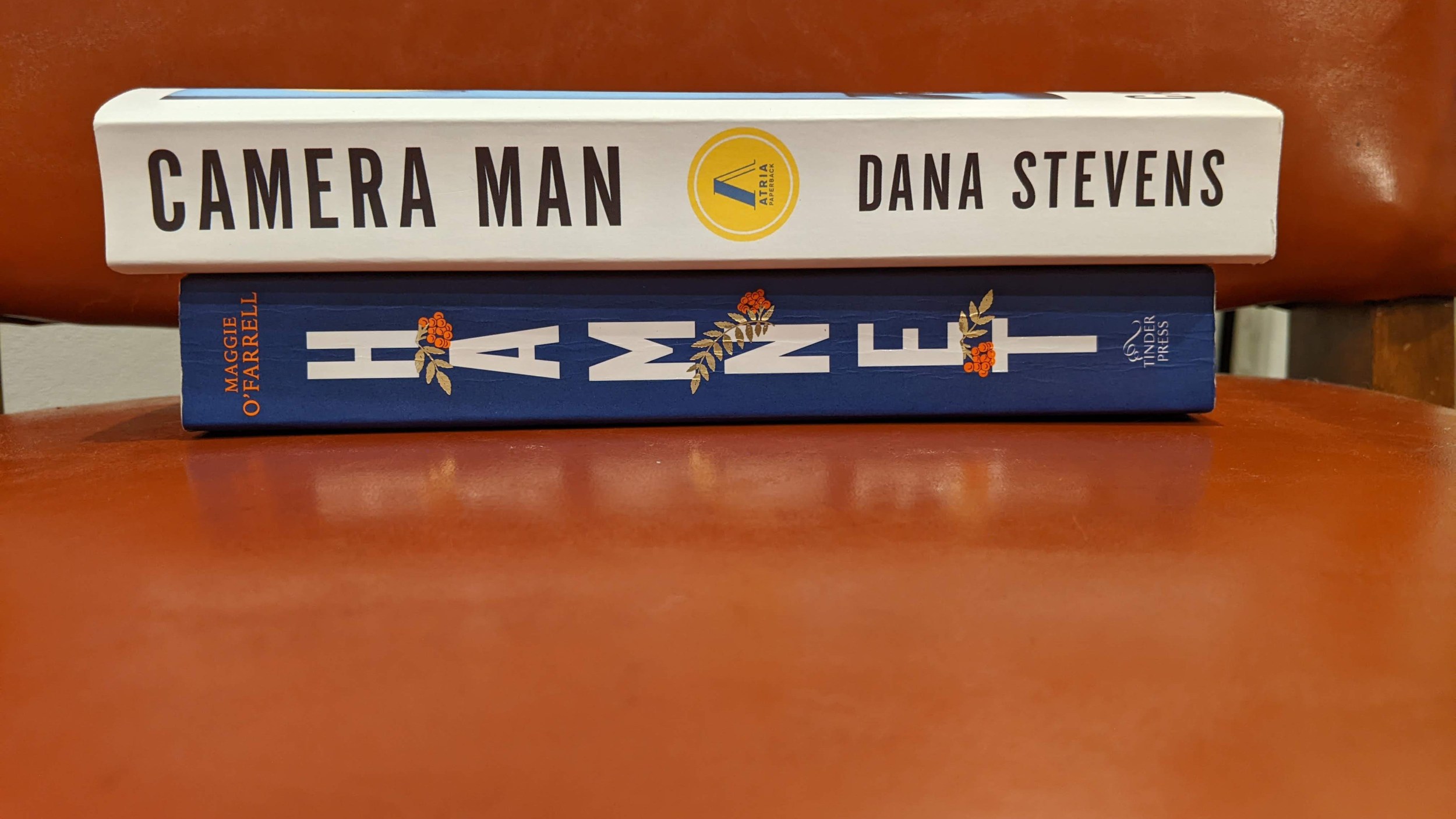
Camera Man by Dana Stevens
Nonfiction, 2022
An older Buster sometimes told interviewers that, given a chance at higher education, he would have liked to study civil engineering. But he proposed this alternate life path without conveying regret or a sense of lack. Rather, there was an implied pride in his status as an autodidact. In his own way, he must have known, he had become a master engineer, one whose materials included not just steel, wood, and electrical circuits but celluloid, light, the passage of time, and the movement of human bodies, especially his own.
Without sacrificing a bit of research vigor, Dana Stevens approaches this biography of the great Buster Keaton with an openness to roam past the usual borders of the form. She brings her critical eye to Keaton’s filmography and frankly assesses the strengths and weaknesses of individual projects. It feels like she’s in genuine, deeply considered conversation with her subject, which makes the trek through his career more fascinating. It also frees up Stevens’s prose, which is often appealingly conversational.
Stevens also occasionally turns the spotlight away from Keaton on occasion. If spending a chapter on a complete different person or subject can provide some added context to the society Buster moved through, Stevens simply does it. The book’s subtitle is Buster Keaton, the Dawn of Cinema, and the Invention of the Twentieth Century, and Stevens takes the third part of that thesis seriously, diverting from Keaton’s childhood in vaudeville, for example, to consider the implementation of child labor laws in the U.S. Though a brisk read, Camera Man feels impressively complete.
Hamnet by Maggie O’Farrell
Fiction, 2020
Agnes is gripping the child’s limp fingers, Mary sees, as if she is trying to tether her to life. She would keep her here, haul her back, by will alone, if she could. Mary knows this urge — she feels it; she has lived it; she is it, now and for ever. She has been the mother on the pallet, too many times the woman trying to hold on, to keep a grip on her child. All in vain. What is given may be taken away, at any time, Cruelty and devastation wait for you around corners, inside coffers, behind doors: they can leap out at you at any moment, like a thief or brigand. The trick is never to let down your guard. Never think you are safe. Never take for granted that your children’s hearts beat, that they sup milk, that they draw breath, that they walk and speak and smile and argue and play. Never for a moment forget they may be gone, snatched from you, in the blink of an eye, borne away from you like thistledown.
Maggie O’Farrell’s dazzling novel imagines the family life of William Shakespeare. Hamnet draws on established scholarship about Shakespeare’s life but is never constrained by it. In part because what’s known about the wife and children back in Stratford-upon-Avon is limited, O’Farrell’s conjecture comes across as sturdy and truthful. A significant amount of that girding comes from the sheer strength of O’Farrell’s prose. She writes the characters — particularly Shakespeare’s wife, often identified as Anne but here named Agnes — with a burrowing intensity that makes their feelings almost palpable.
Based in tragedy, the book is also heartbreaking. After devoting most of her pages to developing an intimate understanding of the characters, O’Farrell spends the second part of novel enveloped in their grief. The author concerns herself with the different ways that greif manifests as well as the hard truth that it never really goes away. Grief evolves rather than dissipates. It all builds to a final scene that is astoundingly great. The description suits the whole book, too.
Discover more from Coffee for Two
Subscribe to get the latest posts sent to your email.
 Coffee for Two