
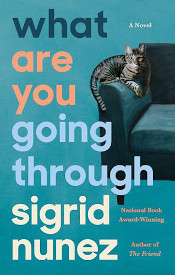
What Are You Going Through by Sigrid Nunez
Fiction, 2020
Is something wrong? asked the trainer.
I shook my head, but then immediately blurted out that a friend of mine was dying.
I’m sorry, he said. Is there anything I can do? Said it reflexively, as people always do, this formula that nobody really wants to hear, that comforts nobody. But it was not his fault that our language has been hollowed out, coarsened, and bled dry, leaving us always stupid and tongue-tied before emotion. A high school teacher once made us read Henry James’s famous letter to his grief-stricken friend Grace Norton, held up since its publication as a sublime example of sympathy and understanding. Even he begins by saying, “I hardly know what to say.
This novel focuses on a friendship between two women who begin as acquaintances before progressing to a much deeper bond after one asks the other for companionship as she prepares for self-administered euthanasia in response to a dire medical problem. The particulars of the plot are glum, but Sigrid Nunez’s writing is sprightly and alert. She approaches the story with a wry, what-can-you-do attitude that positions the challenges faced by the characters as familiar and workaday, putting them on the same level as any number of domestic foibles.
There’s a similarity to the work of Rachel Cusk, particular in the tendency to digress into recitations of other stories and vague philosophizing. It has the effect of experiencing Nunez thinking out loud as she draws on her own learning to make sense of the lives, thoughts, and feelings of her characters. Because of this — and this is the case with Cusk, too — not all of the details of the novel stick in the memory. The cumulative feel of What Are You Going Through is deeply resonant, though. It’s a book that’s lived as much as read.
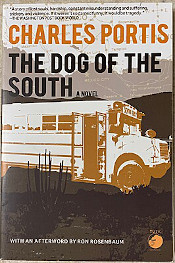
The Dog of the South by Charles Portis
Fiction, 1979
He wouldn’t answer me when I spoke. His plan, I could seem was to keep silent and not acknowledge my presence, except for the countering moves with the shotgun. When he looked about, he pretended not to see me, in the way of a movie actor whose eyes go professionally blank when tracking across the gaze of the camera. The dog picked up on his mood and he too ignored me. Dupree sat there with his magazine, feigning solitude and peace. He fondled his belly and chest with his fingertips the way some people do when they find themselves in swimming trunks. I got one of the rusty cans of warm beer from the trunk and made of show of opening it and drinking it.
The Dog of the South is the third novel published by Charles Portis, and it arrived more than a decade after its direct predecessor, the famed True Grit. Rather than a classic Western, the book is a contemporary tale that traces the path of a worldweary fella who travels to Mexico is search of his wife, who recently absconded with his Ford Torino and her ex-husband in tow. The lead character, Ray Midge, is determined enough but also somewhat lackadaisical. His tracking is done in fits and starts, and he has only the vaguest plan of what he’ll do when he catches up with them, even as he has little doubt that he will.
Portis has an clear kinship with Elmore Leonard and Cormac McCarthy. It’s a testament to the sharp certainty of his terse, focused prose that Portis feels like the forefather to those two, even as he was the latest of the three to put a novel on bookstore shelves. (Leonard had more than a ten year lead on Portis, in fact.) All through The Dog of the South, it feels like he’s invented a cleaner, more solid way to write. There’s some overly casual use of racist language that was already an outdated choice for a white author at the time of its publication date, but it’s redeemed somewhat by signs here and there that Portis is ruefully acknowledging its use among the dwellers on the social fringe he writes about even as he instinctually condemns the offhand bigotry behind it.
Discover more from Coffee for Two
Subscribe to get the latest posts sent to your email.
 Coffee for Two