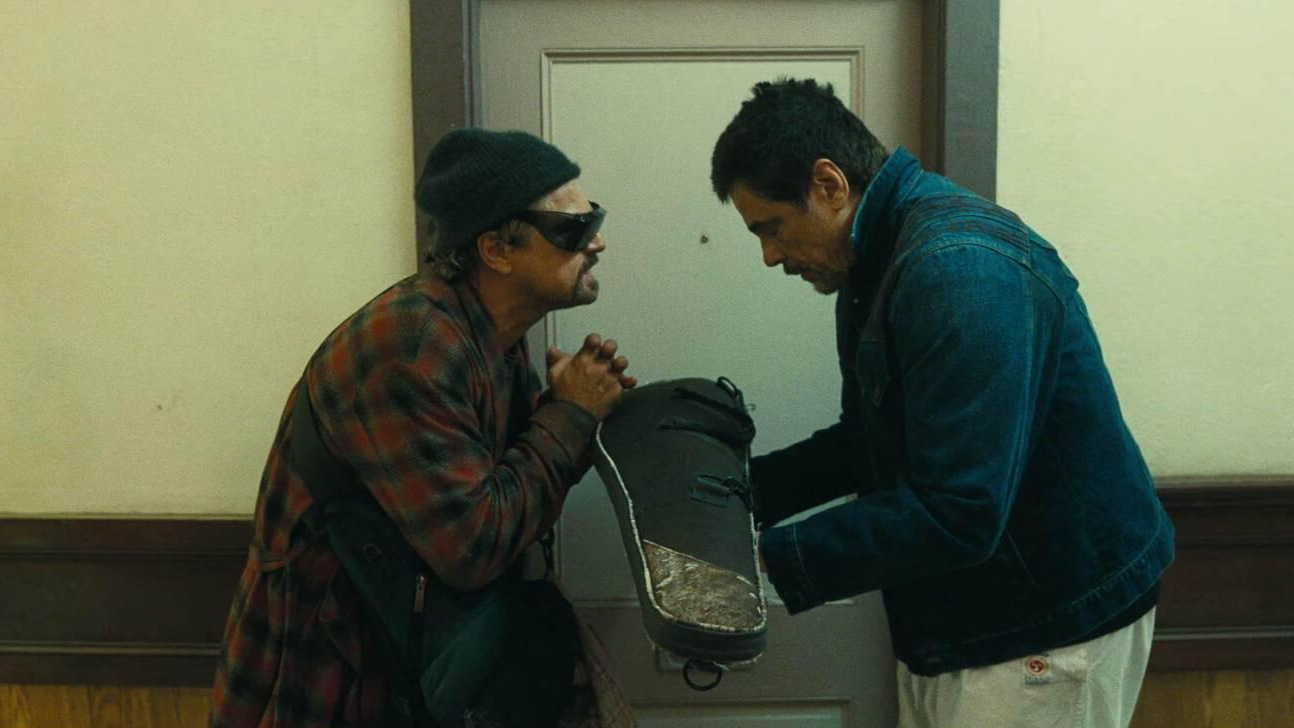
Where do I even begin with Paul Thomas Anderson’s One Battle After Another? It is a film that holds an absurd number of pleasures and practically quivers with thrilling thematic ambition. It is deeply serious in the way it urgently speaks to this precarious moment in the United States, but it is also rambunctious, funny, and wildly entertaining. It is assembled with an expertise in every area of the craft of filmmaking that is so complete and overwhelming that it makes most of its fellow occupants of the multiplex seem almost amateurish in their ability to meet the well-established basics of making film narratives work.
The film is loosely based — or, more precisely, inspired by — Thomas Pynchon’s 1990 novel, Vineland. It is about revolutionaries, starting with them at the height of their violent fervor and quickly proceeding to the point when the rumbling tank of state oppression has driven them underground. The onetime bombing expert who went into hiding under the name Bob Ferguson (Leonardo DiCaprio) represents the burned-out version of past idealism. He wastes away his days in a haze of pot and alcohol, mustering only enough energy to testily dote on his daughter, who goes by Willa (Chase Infiniti). He is finally roused to action by the reemergence of Col. Steven J. Lockjaw (Sean Penn), a petty, snarling military man whose obsession with Bob’s former outfit, the domestic terrorism group known as the French 75, was largely driven by an insatiable lust for Perfidia Beverly Hills (Teyana Taylor). Perfidia was Bob’s partner and Willa’s mother, so the renewed pursuit seethes with the personal.
On the framework of this story, Anderson spiderwebs a wealth of detail, ideas, and commentary. The manifesto of the French 75 is kept relatively vague, but their righteous crimes seen on screen suggest an animus towards anti-immigration cruelty, capitalism, and, well, just about all the cherished tenets of right-leaning America. The film is populated by dissatisfied schemers and dreamers, and it places its sympathies squarely with those who wearily strive to improve the lives of the downtrodden and against the bigots and blowhards propping up the world’s most insidious social structures. In doing this, Anderson somehow manages to be realistic without becoming cynical. It helps, perhaps, that he couches some of the harshest points in blunt satire. No matter how bleak the material might get — and there are betrayals, bloodied bodies, and unpleasant truths aplenty — Anderson never relents from the certainty that the punishment the villains most deserve is unchecked mockery.
The cast is uniformly superb. DiCaprio keeps digging to find new inners wells of bedraggled anxiety and desperation, and Infiniti effectively comes across as both sullenly sheltered and simmering with rebellion that’s built into her DNA. With fiercely committed character work, Penn embodies a certain type of small, angry man, marching through the world with the stiffness of a G.I. Joe that has some of its joints melted together, his animosities huffing out of him like cigarette smoke from a two-pack-a-day lost cause. As Sergio St. Carlos, a benevolent karate teacher who dabbles in his own raging against the machine on the side, Benicio del Toro is relentlessly inventive in his performance, playing gentle kindness as a type of rascally civil disobedience.
Every piece of One Battle After Another is spectacularly realized, and the whole of the work is still so much greater than the sizable sum of those parts. Although the film is long, it moves at a headlong clip, mostly because Anderson is sharply economical in his storytelling. So much is there, and none of it is waste. The director works with editor Andy Jurgensen to ensure that no scene — no moment — stretches even a second too long. Jonny Greenwood’s plunking, piercing score further heightens the tension. Cinematographer Michael Bauman gives the film a look that is at sharp and rich, seeming to draw equal inspiration from some of the grandest achievements of nineteen-seventies Hollywood cinema: the paranoid political thrillers and the moody muddles of Robert Altman’s ambitious, wry dramas of a nation at war with itself.
Anderson already has enough consensus masterpieces on his resume to put a foolhardy tinge to any qualitative assertions of previously unreached greatness, but I can’t help myself. Any other conclusion I might offer would be dishonest. One Battle After Another is best movie that Paul Thomas Anderson has ever made.
Discover more from Coffee for Two
Subscribe to get the latest posts sent to your email.
 Coffee for Two