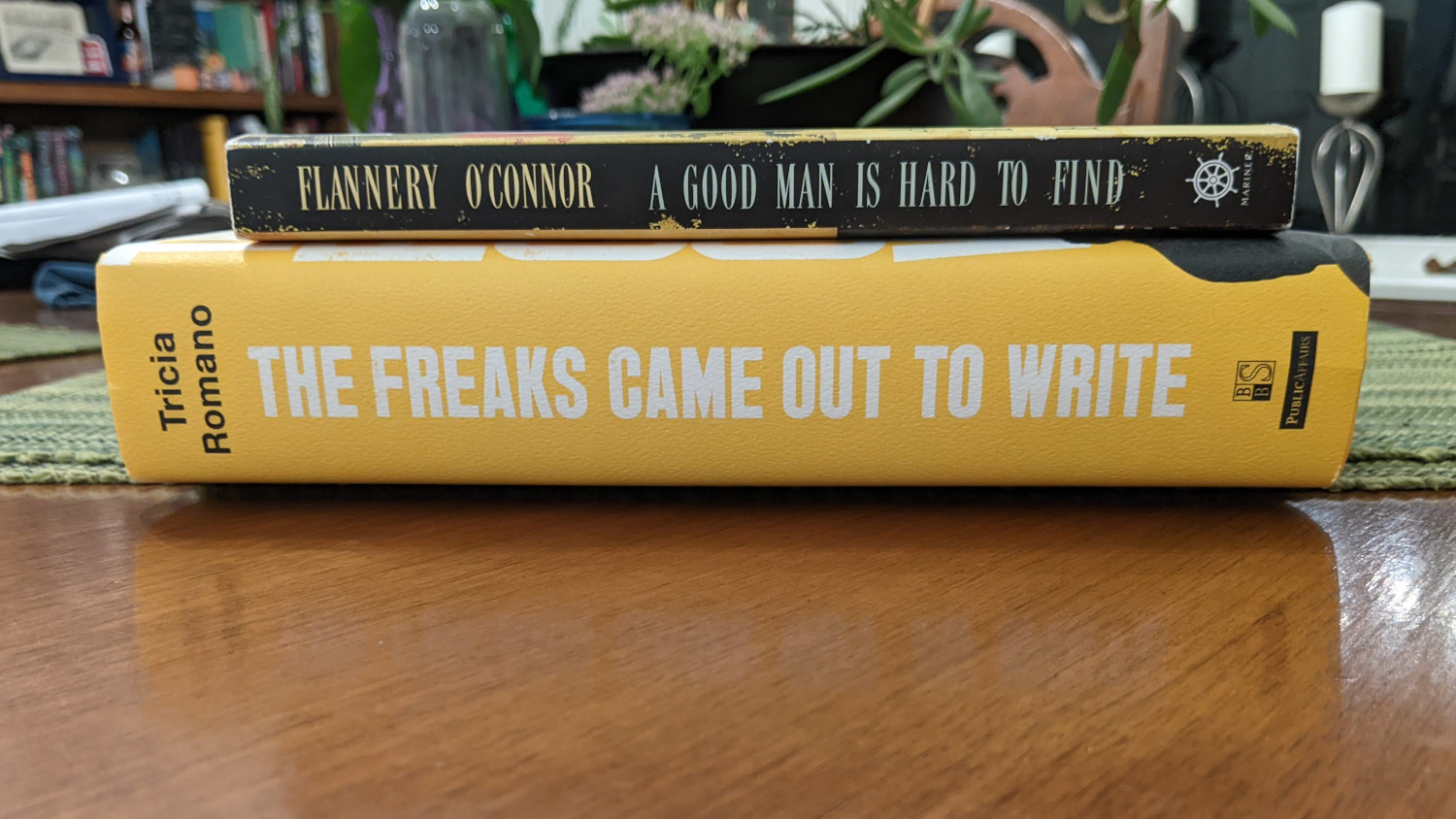
A Good Man Is Hard to Find and Other Stories by Flannery O’Connor
Fiction, 1955
Besides the neutral expression that she wore when she was alone, Mrs. Freeman had two other, forward and reverse, that she used for all her human dealings. Her forward expression was steady and driving like the advance of a heavy truck. Her eyes never swerved to the left or right but turned as the story turned as if they followed a yellow line down the center of it. She seldom used the the other expression because it was not often necessary for her to retract a statement, but when she did, her face came to a complete stop, there was an almost imperceptible movement of her black eyes, during which they seemed to be receding, and then the observer would see that Mrs. Freeman, though she might stand there as real as several grain sacks thrown on top of each other, was no longer there in spirit. As for getting anything across to her when this was the case, Mrs. Hopewell had given it up.
A Good Man Is Hard to Find was the first short story collection published by Flannery O’Connor, and it probably still stands as the prime testimony in support of her elevated stature among American authors who primarily toiled in the middle of the twentieth century. The argument is convincing. O’Connor’s prose is classically structured and solid as a brick. It’s lean and yet sharply vivid, filled with telling details and broadly impactful characterizations. The people moving through these stories carry whole lives with them.
Because O’Connor is writing stories set in the U.S. below the Mason-Dixon Line with copyright dates that all precede the nineteen-sixties, there’s a lot of racist language here. It’s not celebrated but nor is it presented as indicative of backwards attitudes or ignorance; it’s just the reality of how these characters see the world. Consumed with more modern attitudes, the casualness of how these words are deployed occasionally crossed over to unpleasant for me, even as I recognized the value of O’Connor’s honesty about the time and place.
The Freaks Came Out to Write by Tricia Romano
Nonfiction, 2024
ERIKA MUNK: I started to write in 1976. I became senior editor in ’78. Ross wanted to be a general editor of the features, the long stuff, and I handled the reviewers.
It was a pretty big theater section. I had three pages normally. I had four regular reviewers. Michael Feingold was the lead critic.
MICHAEL FEINGOLD: Erika is a major figure. She also used to write letters to the paper complaining about the reviews under the pen name Phyllis Stein. But I didn’t tell you that. Erika as an editor was much more directly challenging. She would ask the hard questions up front, and that’s useful in a different way.
Every now and then Erika would make a draconian cut. I would come up with a very elaborate first paragraph, and she would glare at me and say, “You’ve been reading Henry James again.” And she was right.
Tricia Romano has written for a slew of outlets, including, for a time, The Village Voice. It was at a reunion of several staff members conducted in the twilight of the New York journalism institution’s time as a print publication that Romano decided to document its history while the many of the people who lived that history were still around to tell the tale. She assembles The Freaks Came Out to Write as an oral history, sometimes drawing from quotes printed or aired contemporaneously to the events the recount but largely comprised of responses to her own interviewing. She does an amazing job of teasing out all the messiness and contradictions this icon of alternative media.
Romano favors short, punchy chapters, so this cinder block of a book feels like a brisk, easy read. Then again, my impression might be heavily influenced by the fact that these sorts of stories — of muckraking journalism, pointed editorializing that provokes people in power, rambunctious arts writing, and miscreants collaborating uneasily to put a piece of left-of-center media into the world — are plainly irresistible to me. The oral history format makes it that much easier to feel immersed in the culture, and I was delighted to spend a good amount of time there.
Discover more from Coffee for Two
Subscribe to get the latest posts sent to your email.
 Coffee for Two