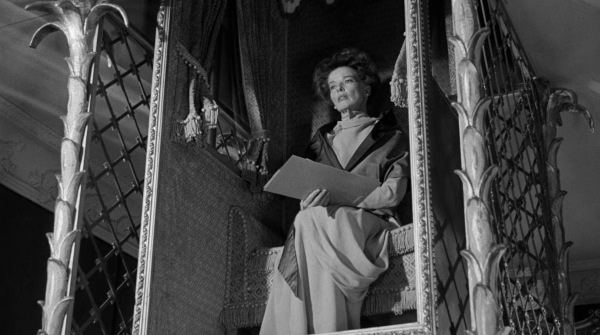
Suddenly, Last Summer (Joseph L. Mankiewicz, 1959). Until Joseph L. Mankiewicz presses a little too hard to make the whole thing more cinematic during a late, revelatory monologue, this adaptation of a Tennessee Williams stage work cracks off a series of great scenes that are essentially fierce two-handers. Dr. John Cukrowicz (Montgomery Clift) is a star surgeon in New Orleans who has gained particular renown for performing lobotomies. He’s recruited by a wealthy woman named Violet Venable (Katharine Hepburn) to diagnose her troubled, institutionalized niece (Elizabeth Taylor) in the hopes that he’ll perform the brain-burrowing procedure on her. The drama in Suddenly, Last Summer is florid in a manner perfected by Williams, and Mankiewicz accentuates the hothouse intensity of it all. The effectiveness of the acting ranges widely, and sporadic, indifferent stabs at Louisiana accents make the New Orleans setting basically an afterthought. The clear standout in the cast is Hepburn. She’s consistently fantastic as an imposing, irritable matriarch with unveiled contempt for most of the people around her and a base inability to conceive of scenarios in which she doesn’t get precisely what she wants.
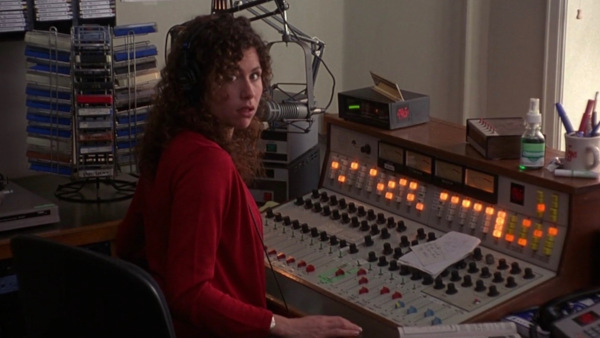
Grosse Point Blank (George Armitage, 1997). One thing’s for sure: Minnie Driver deserved a better career than the one Hollywood was willing to give her. She’s wildly charismatic and endlessly appealing in this deliberately odd comedy about a hitman (John Cusack) on the verge of burning out who attends his ten-year high school reunion in the Detroit suburbs. Driver plays the girl he left behind, jilting her on prom night to start down the path that led to his vocation a contract killer. She stayed behind in their hometown, eventually working as a cool-voiced DJ at the local radio station. Cusack cowrote the screenplay with some of the same cohorts who he would later collaborate with on an adaptation of Nick Hornby’s novel High Fidelity. They present the film’s story with an archness that is sometimes witty and sometimes distancing. George Armitage’s direction is nicely restless and yet also smartly efficient; he keeps the action moving briskly enough and effectively handles the tonal shifts between dark jokes and warm relationship comedy. Grosse Point Blank is imperfect, but it succeeds far more often than it falters.
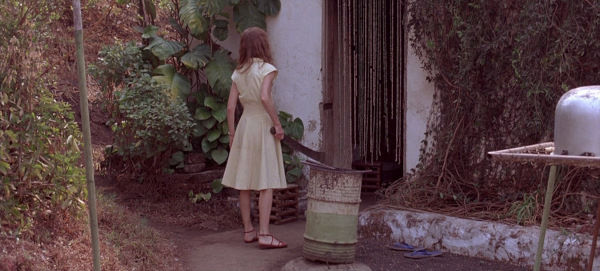
White Material (Claire Denis, 2009). Cycles of violence and oppression never stop spinning. They rarely even slow down. Claire Denis’s White Material is fiercely aware of this hard truth and plays out the thesis with meticulous care. An African country is in the last days of French colonial rule, and local militias are asserting their newfound authority in a rising civil war. Against this fraught backdrop, Maria Vial (Isabelle Huppert) is trying to hang on to the coffee plantation she runs with her fractured family. Denis is co-credited on the screenplay with Marie NDiaye, and their storytelling is meticulous and harrowing in equal measure. Every bit of Maria’s life exists in a state of constant danger, ready to collapse or implode at any moment, depending on which threat asserts itself most forcefully. Huppert is restrained and affecting in the lead role, making Maria’s tense navigation of her situation piercingly real. There’s also a fine supporting performance from Christopher Lambert, playing Maria’s weary ex-husband. Denis is a fine visual stylistic, and those skills are fully evident here. The film is intensely cinematic without sacrificing a bit of emotional integrity.
Discover more from Coffee for Two
Subscribe to get the latest posts sent to your email.
 Coffee for Two