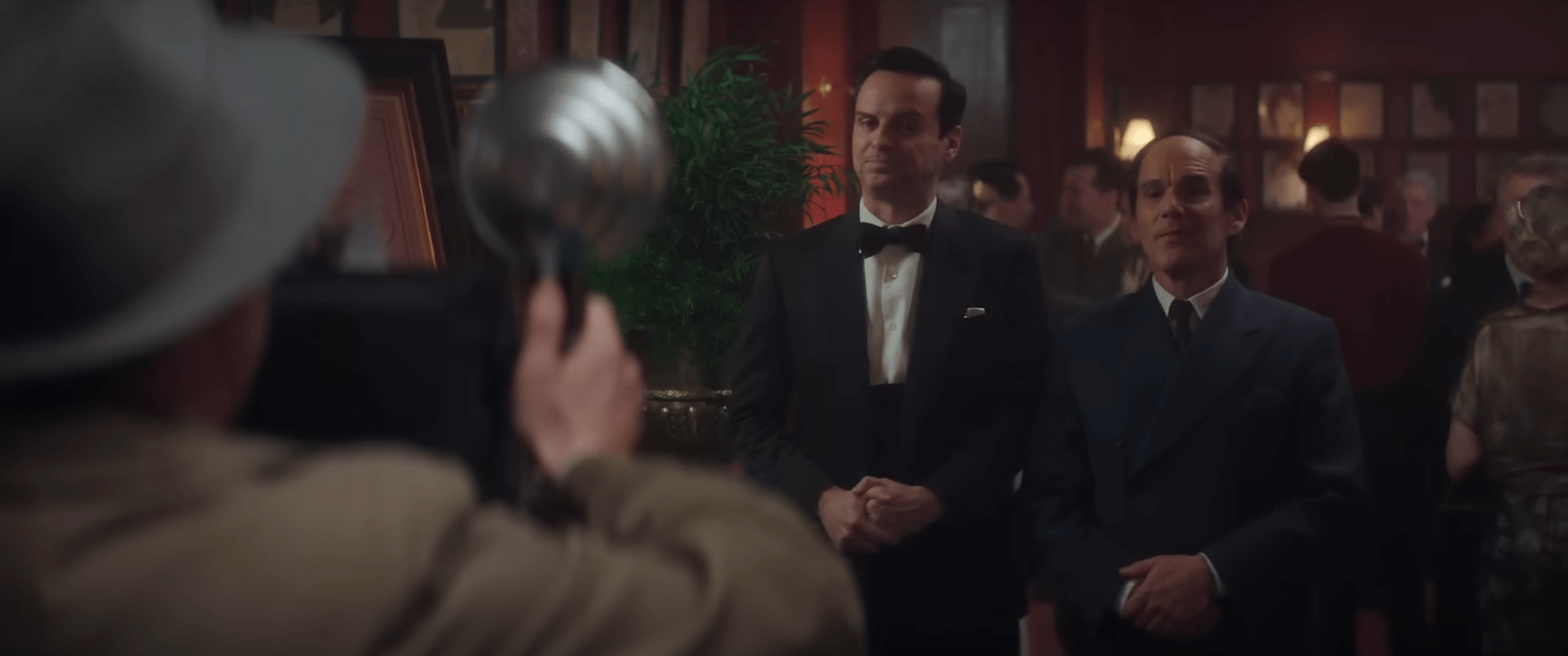
Blue Moon takes place almost entirely on the Broadway opening night of Oklahoma!, the 1943 cornpone musical that was so successful that it set new standards for a smash. For most of the people gathered at Sardi’s to celebrate the boffo debut, it’s a night of boundless pride and jubilation. Over in the bar, a different mood prevails. Renowned lyricist Lorenz Hart (Ethan Hawke) is wittily holding court and nursing understandable bitterness over seeing his longtime creative partner, composer Richard Rodgers (Andrew Scott), move on to a new collaboration that is already proving wildly prosperous.
There is probably no director working today who’s better suited for this sort of tart, talky material than Richard Linklater. The screenplay by Robert Kaplow (who wrote the book Me and Orson Welles, which Linklater adapted to the screen more than a decade ago) is structured like and adheres to the rhythm of a play. Other filmmakers might furtively hunt for ways to gussy up the cinematic technique in an effort to make the work feel less stagebound. Not Linklater, though. He leans into what he has, relishing the pleasure in smart people (or at least smart alecky people) trading finely sharpened words. Linklater similarly embraces every strong emotion in the story. As Lorenz is lamenting his professional doldrums, he’s simultaneously giving himself over to boyish pining for Elizabeth (Margaret Qualley), a college student and aspiring stage designer who’s half his age. The pathos hangs in the air like a resonant tune.
By opting for understatement in his directing, Linklater provides room for his actors to go a little broader. They are up to the challenge, winningly so. Scott manifests the mixed emotions felt by Rodgers as looks to a brighter future that necessitates largely leaving his cohort, and Qualley gives Elizabeth a joyful snap borrowed from the screwball comedies of the era while still showing the real person inside this idealized figure. There are also solid supporting turns from Bobby Cannavale, as a good-guy bartender, and Patrick Kennedy, embodying the weary civility of E.B. White. It’s Hawke who the film is built for, though. The longtime leading player in Linklater’s troupe goes at Lorenz Hart with hammy abandon, and it’s a delight. Hawke brings the same gusto that’s defined the best of his recent television work (most vividly in The Good Lord Bird) and applies it to a more intricate portrayal that combines mannerisms with keenly felt depth.
There’s a lot of interesting ideas about art and the people who make it to be found in Blue Moon. It’s never insular or ponderous its ruminations. As he has many times before, Linklater finds engaging drama and comedy in well-drawn characters exchanging their thoughts. Blue Moon sings.
Discover more from Coffee for Two
Subscribe to get the latest posts sent to your email.
 Coffee for Two