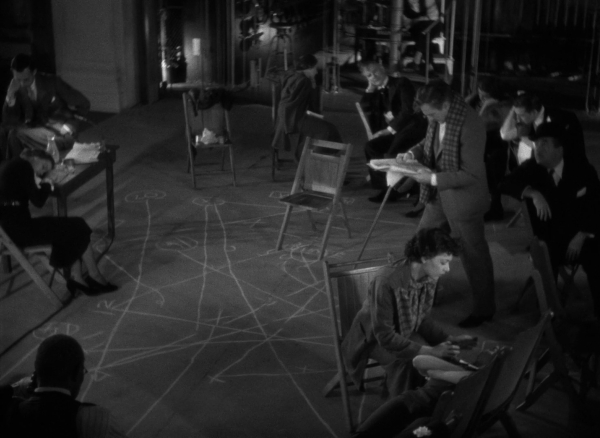
Twentieth Century (Howard Hawks, 1934). This comedy has less satisfying snap than I typically associate with the screenwriting of Ben Hecht and Charles MacArthur. It gets by on volume rather than wit. An imperious theater director (John Barrymore) impulsively chooses a starlet (Carole Lombard) for his latest production and proceeds to bully and cajole her into fitting the image he has for her in his head. The two spend years in a fraught personal and romantic relationship before she frees herself then subsequently achieves stardom in Hollywood. The two reunite in a swirl of screwball activity during a cross-country train ride. The angry codependence of the central relationship in Twentieth Century hasn’t aged well, giving the comedy an acrid tinge. Still, Lombard is pretty amazing in the film, especially in her rapid pivots between extreme emotions. And Howard Hawks’s direction is remarkably deft and fluid for this era when most Hollywood productions were still visually stiff.
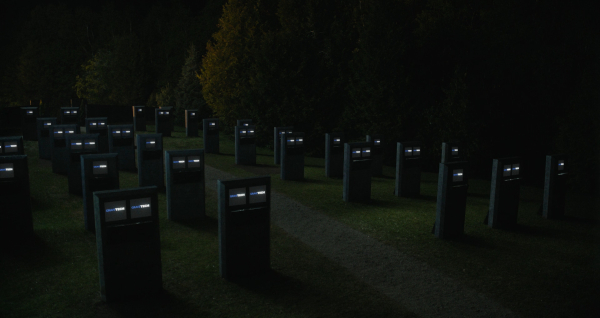
The Shrouds (David Cronenberg, 2024). At a clinical remove, it’s fascinating that David Cronenberg channeled his personal grief after the death of his wife into the same sort of conspiratorial, body-horror fever dream that he’s been making his whole career. I just don’t think it resulted in a good movie. Karsh (Vincent Cassel) is an entrepreneur who responds to the passing of his spouse by inventing and marketing a service that buries a camera with deceased loved ones so images of their decomposition can be displayed on their tombstones. At around the time mysterious figures start vandalizing Karsh’s digitally upgraded cemetery, he falls into psychosexual relationships with a business partner’s blind wife (Sandrine Holt), his dead spouse’s twin sister (Diane Kruger), and a vaguely porny A.I. assistant (voiced by Kruger). Being Cronenberg, he makes room for disturbing fantasies of bodies in different stages of disassembly. Where The Shrouds should be brooding and affecting, it’s instead leaden and silly. Cassel joins Cronenberg’s long line of oddball actors who step into a lead role and offer the most pronounced version of themselves. In the case of Cassel, that means a performance that’s as wooden as an oak bench.

Sneakers (Phil Alden Robinson, 1992). Sneakers is so handsomely mounted that identifying the handful of plot cheats feels needlessly persnickety. This film features one of Robert Redford’s finest performances of pure star power; he plays Martin, a computer hacker with a strong anti-authority streak. Martin leads a crew of brilliant misfits, each with a special skill or two that comes in handy for schemes of corporate espionage. They make their collective living demonstrating to companies where their cybersecurity vulnerabilities lie. The group is recruited to retrieve a special device that can fell any computer’s defenses, giving a user access to all the data in the world and the ability to, say, shut down a country’s entire electrical grid or launch a few nuclear missiles for kicks. Robinson is co-credited on the screenplay with Lawrence Lasker and Walter Parkes, the team that wrote WarGames. The fundamentals of their technology-based story hold up well, which is certainly not the case with a lot of similarly focused movies of the era. Sneakers is a smashing entertainment that sets up audience-pleasing moments and expertly delivers on them. Everyone in the absurdly talented cast is terrific; I was especially charmed during this most recent viewing by the variety of ways Sidney Poitier found to be comically exasperated with Dan Aykroyd’s reasoned presentation of outlandish conspiracies.
Discover more from Coffee for Two
Subscribe to get the latest posts sent to your email.
 Coffee for Two