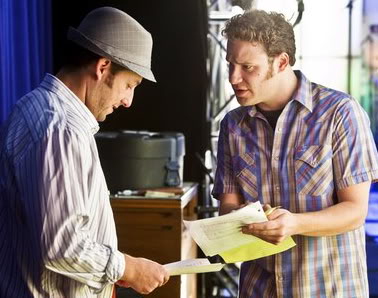
Writer-director Judd Apatow’s new movie Funny People has a lot of dick jokes in it. A lot. If you’re an undiscerning fan of dick jokes, finding each and every one of them hysterically funny, then this movie may actually be dangerous to see. You’ll be doubled over with laughter, completely breathless. Watching this movie could kill you: death by comedic asphyxiation. That’s how many dick jokes there are. If you’re a more discriminating fan of dick jokes, appreciative of a well-constructed dick joke but not prone to automatic laughter just because it’s a joke about a dick or ball or a dick and balls together, then the movie will be scattershot affair. The dick jokes generally aren’t that clever. They’re mostly quick, reflexive statements, with barely any humor attached beyond the simple fact that they’re about dicks. If you’re someone who hates dick jokes, never heard one you liked, then Funny People is going to be a rough two-and-a-half hours.
Then again, maybe not. The above assertions presupposes that the dick jokes are supposed to be funny, or, more to the point, that the film benefits from the dick jokes being funny. While Apatow is clearly going for laughs with much of the film, in many ways this is more clearly a drama. It primarily involves around a stand-up comedian turned movie star whose empty, fairly miserable life is further upended by a dire diagnosis involving a rare blood disease he’s contracted. It’s that character who tells a lot of the dick jokes, though not all of them. Whether they’re funny or not, they serve to illustrate his isolation, his inability to communicate with anyone except through the juvenile humor that have earned him his millions. There’s a telling moment when he’s walking through the gardens on his estate and he compliments the gardener on the roses. The gardener thanks him. The movie star, unable to come up with anything else immediately resorts again to a dick joke, just as he utilizes silly voices when making phone calls and generally avoids interacting with any other human being without erecting a wall of comedic distraction. Apatow has defended all the dick jokes as being an accurate depiction of how comedians talk to one another, even joking that he had to dial it back from what real patter sounds like backstage at The Improv. That may be true, but the better reason for them to be there is that they actually serve as an illustration of the arrested development and the neediness of the characters who fall back on them. That may not have been Apatow’s intent, but it’s part of the result.
Adam Sandler plays the dying star, George Simmons, and he carries the baggage of his own career into the role. George’s home is filled with posters for spectacularly awful–looking movies, any of which you wouldn’t be surprised to see Sandler actually do. Sandler taps into dark places for the performance, showing the way George barely conceals the anger and self-loathing that drives him. There’s often an undercurrent of rage in Sandler’s performances, but here it plays as dangerous instead of just unpredictable. While it certainly isn’t, the performance feels like a confessional, lending weight to the already nice work Sandler is doing. It’s a testimony to Sandler than he sometimes makes his partners onscreen look too loose, to peripherally engaged with the material. Particularly suffering in comparison is Seth Rogen as the up-and-comer pulled into the star’s orbit. Rogen remains an amiable presence, but there are a few moments, even key moments, where it’s clear he still needs to bone up on the craft of acting.
While only his third film as a director, Funny People is unmistakably an Apatow product, for good and bad. There’s no shortage of ideas in the movie. Apatow makes room for examinations of the different levels of fame, the way self-interest trumps friendship in show business, the coping mechanisms comedians would employ in the face of death, the ways families grow apart. And that’s all before he gets into the subplot about George trying to win back the woman he betrayed over a decade earlier, viewing the happy domesticity she achieved since as the precise thing he needs to mend his loneliness. That introduces a whole new set of ideas. Sometimes it feels like too much. You admire Apatow’s ambition even as you’re swamped by it. He remains incredibly undisciplined as a filmmaker. His films may be tested as reshaped repeatedly before release, but they all feel like products of a meandering mind. This isn’t automatically a problem–there have been plenty of great films over the years that could be described in exactly the same manner. Apatow, though, isn’t quite inventive enough to pull this sort of thing off. He’s a skilled satirist (besides the dreadful comedies papering the walls, there are glimpses of a dreadful sitcom that could have many any of the network’s fall schedules) and an empathetic humanist, but he lacks the audacious creativity to overcome the slapdash construction of his films. Like his characters, it sometimes feels like Apatow’s got a lot more to give, if he’d just learn to stop hiding behind all those dick jokes.
(Posted simultaneously to “Jelly-Town!”)
Discover more from Coffee for Two
Subscribe to get the latest posts sent to your email.
 Coffee for Two