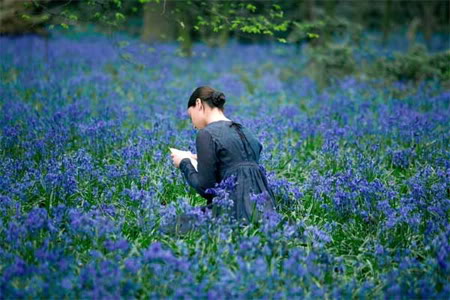
It is perhaps fitting that Jane Campion has made her finest film since The Piano by turning to a poet. Much of what makes the film that won her a best screenplay Oscar and only the second woman in Academy Awards history to be included among the Best Director nominees is an uncanny ability to realize all the finest attributes of poetry in her visual work. There is an economy and efficiency operating in tandem with striking, evocative imagery. There is a forcefulness to the open, piercing emotions. Appropriately, given the mute lead character, it says more with less, achieving more heat, for example, from a worn hole in a stocking that other films do with the steamiest sex scenes. Campion’s new film is not on par with The Piano, but it is her first since that offering to demonstrate gratifying echoes of the artistry that enriched her finest work.
Bright Star is about 19th century English poet John Keats. More accurately, it about his romance with a headstrong young woman named Fanny Brawne. Knowing the era it takes place in, there’s a decent chance you can recite the components of this film: the impediments to their romance built around class and station, the moments of swooning elation and piercing heartbreak, the clipped refinement of their exchanges. Even without any sort of working familiarity with the tragic circumstances of Keats’s life, much of the overall structure and direction of the story works in a well-worn progression. Campion elevates it through the conviction of her work and the gentle daring around the edges.
This is seen most clearly in the performances, a group of splendidly inventive collaborations between Campion and her actors that shifts the film from the staid safety that can often make period pieces feel embalmed. Abbie Cornish brings a briskness to Fanny Brawne, an open vividness that adds immediacy to the romance. The emotions practically shimmer off of her as she finds herself drawn to this moody man. As Keats, Ben Whishaw manages to pull off the daunting task of believably portraying someone who expresses the intellectual and emotional meanderings of his soul with resonant, literate language. Best of all is Paul Schneider as Keats’s formidable and protective colleague, Charles Armitage Brown. Barely a line goes by without Schneider giving it a crafty reading, exuding the egotism and exasperation of a man accustomed to being the more intelligent than anyone else in the room even as he’s continually humbled by the striking talent of his closest friend. It’s a lively take on a role that could have easily been blandly misanthropic.
Jane Campion makes it all work with great elegance. The film is refined, but also smartly earthbound. The exchanges don’t feel like distant literary or historical material, but like deeply felt exchanges between realistic, recognizable people. Campion occasionally captures beautiful images with her camera, but more often she’s using it with measured storytelling skill, figuring out the most effective way to clearly tell her story and find the cleanest ways to cut through to the inner workings of her characters. In a way, she simply shows the way poetry can be achieved with the mechanics of filmmaking, the artistry flicking by at twenty-four frames per second.
(Posted simultaneously to “Jelly-Town!”)
Discover more from Coffee for Two
Subscribe to get the latest posts sent to your email.

